

Embodied Patterns.
You are going to rewrite your roles. These roles kept you alive - you don’t need them any longer
Embodied Patterns: The Four Roles in Families With Dependence
When we discuss 'role', we mean something fundamental and authentic. This is about your genuine self, how you truly interact with others, not a performance or a persona you put on. We're exploring your authentic way of being, stripped of pretence or social masks.
The effects of the trauma that you suffered is always there between you and others. It determines how you act, think and feel at all times during the day. It shields you from your true self and the beauty and wonder that is you.
The next two actions will enable you to slowly take off the cloak of the spell and reveal your beauty. It will give you new power to determine your own actions, thoughts, and feelings.
This is my story, you may have your own story about how you used the roles in your own family of origin. If so, this is the place to share it, otherwise feel free to use my story.
I learned early on that if I acted in a certain way, predictable things would happen. If there was tension in the house and I didn’t know why, I would do something silly to make everyone laugh. If Mum was sad, I would try to cheer her up or look after her in some way. Sometimes I would shepherd the smaller children away from the raised voices, to the bedroom where I would read to them. I would tidy up. I would work hard to make things better. I sometimes diverted attention by breaking something. Or by fighting with a sibling. But most often I would go away and read a book. By myself. Out the kitchen door, down the path, past the shed and the vegetable garden. Past the old rusting car dad was fixing up. Past the garage where Mum and Dad and their friends would play darts and pool all weekend. I would head for my tree. I loved that tree. It was a pear tree and was easy to climb. The pears were delicious. There I would hang out with my imaginary friends Alice in Wonderland, Tarzan of the Jungle, Katy, The Famous Five; anyone I could get my hands on. I would go into their world; they welcomed me. Pears are still my favourite fruit. They represent safety to me. I can see how things haven’t changed much since I was a child. If a tense situation comes up, I either make a joke or disappear. There are more effective ways of dealing with tension.
My life’s work is to find out more about the effects of the trauma that happened to me, and how it has shaped me. I thirst for this knowledge, because I know deep within me that this is the way to find the remedy.
Following is some education about the four family trauma roles in a family with dependence.
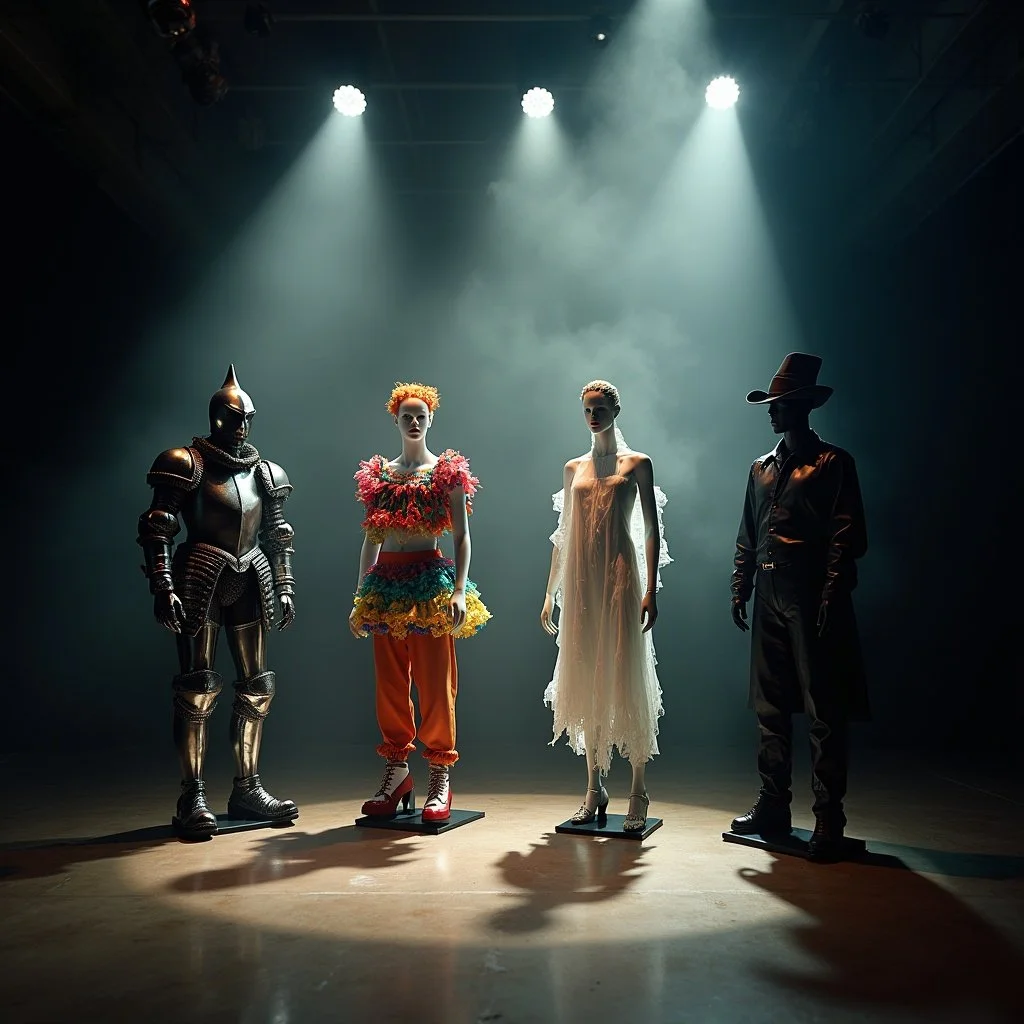
Educational Insight - Family Trauma Roles
All children play their roles in any family; addictions or no. The clown, the scapegoat, the clever one, the naughty one. The easy going one. The sporty one. The popular one. The antisocial one. The TV show Modern Family is a classic example of children’s roles in a family. Hayley is the people-smart, pretty, popular one. Alex is the nerdy, unconfident over-achiever. Luke is the goofy one. In a family with no trauma caused by dependencies, children get to try on different roles. We call these children well-rounded. The clever child may take up a sport, or the clown may become serious. Their lives don’t depend on their roles. In the traumatised family, the children’s roles are born of fear and shame. As a result, they become locked into those roles. We base our roles on our perception of what we need for survival. We adhere to our role to such an extreme that what was positive becomes negative. There is no choice of a different role, no way to learn balance and acquire the skills to change. We become solidified in the effects of the trauma. Where can you go as an adult to practice different roles? How can you learn new roles? We are going to look into this later in this session.
If we look at the family as a system, we see that each person takes on a particular role. When one person tries to change their role in the system, it forces others to change their own roles. If the acting-out child became the family hero, the system would collapse. This helps to keep us locked into our roles.
My Story
Even though I am the oldest child, I was never the responsible one; my younger sister took on that role. My younger brother played the role of acting out. My youngest brother I don’t know about. He was only four when I left home. Knowing him now as an adult, I suspect he took on the Mascot role when I left.
I sometimes played a combination of roles. Sometimes I was the Adjuster, who would adapt to any situation. The one who opted out. The avoider. Also called the Lost Child. I preferred to be the child that we call the Placater, also known as the Mascot. I would adapt to any situation and even make those involved feel better about it. As a child, I mediated fights between my parents. Nothing affected me. We’re going out for dinner – awesome. Oh, we’re staying home now? Awesome, are you ok? No Christmas present? No problem, it doesn’t matter. Do you like the present I bought you? I could accept any situation and make the best of it. As a child, I perfected making others feel better. If there was any tension at all, I would make everyone laugh. I became very good at clowning around.
Because everyone loves the Mascot, they shelter us from what’s going on. Everyone else knows what’s going on but them.
My sister astounded me a couple of months ago with all sorts of knowledge that she had about the family; things I had no clue of. I never knew that she stayed home so much to look after the little ones. I knew that Mum went away after her suicide attempt, but I didn’t know where or why. I didn’t even know it was a suicide attempt until I was 30!
This is how the Placater role works out for me today. The time when my children were little was the best time in my life. I could make them feel better all day, every day. We laughed a lot. Now, I work as a massage therapist and am training to be a psychotherapist. “I want you to feel better”. Everyone agrees that I’m nice and caring. My ethos is “if I am nice, you will like me”.
It’s easy for Placaters to be warm, sensitive, caring, and to listen. Everyone likes us. As children, we had to survive, and to do that, we had to look after everyone else. As adults, we choose professions that enable us to work to our strengths. Nurses, teachers, counsellors, massage therapists, beauticians. This is not a bad thing; we need more caring in the world. But it becomes a bad thing if the giver can’t receive it. Our motivation is “if I look after you, you won’t leave me”. We are able to function adequately and look like a normal person, but when the pressure is on, we revert to our predominant roles.
You may recognise yourself in the following roles. This is the way in which the effects of trauma have formed you.
Mascot/Placater
The Mascot is often cute, fun to be around, and uses humour to survive. No one sees the fear or insecurity deep inside. The Mascot is more sheltered than the other children from knowing what’s happening in the family. They have a well-developed wall of defences:
They may be clumsy or accident prone
They will do anything to attract attention
They may have learning disabilities
They are immature
They can feel crazy at times
They can be super cute
They are always busy
They have a short attention span and can be hyperactive/disruptive/ confused
They have a great sense of humour and are always clowning around.
These defences serve to hide their deep feelings of fear, shame and confusion. They hide anxiety and insecurity, afraid of being judged ‘dumb’. Deep down they are very serious. Their focus is on fun, yet they have a strong sense of abandonment, which may be an accurate barometer of stress in the family. As an adult, the Mascot may have eating problems. They are entertaining and appear cheerful and witty. They may partner with a Hero. They are good friends to have due to their sense of obligation to others.
There are definite positives to being the Mascot. You are fun to be around and lively with a good sense of humour. You know how to lighten and ease tension - you have absorbed all the tension in your family growing up. You are interesting and stimulate those around you. You are creative and can blend with many different types of people. It’s ok for you to get your needs met. You need physical touch. You need information. You need others to ask for your input and for them to take you seriously. You can also learn to accept responsibility. You can develop alternative behaviour instead of making jokes all the time. You can learn to feel comfortable with feelings of sadness or grief. You can learn to laugh on the inside as well.

Family Hero
This child feels responsible for the family pain. They work hard to make things better for the family. They don’t seem to bear any scars. At all. The positive characteristics of the Hero are that they are:
Responsible
Dependable
Hard working
Achievers
Successful
Focused
Generous in praising others
Leaders
Survivors
Loyal
Powerful
Organised.
They do have negative characteristics also. They can:
Be inflexible
Fear intimacy
Be overly driven
Be unable to play
Have unreasonable expectations
Fear failure
Experience guilt easily
Have trouble getting personal needs met.
A fierce need for approval drives Heroes. They are super responsible and successful. They appear to have it all together and believe themselves to be special. They hide their deep feelings of inadequacy well. They feel that nothing they ever do is good enough. Their gift to the family is pride in their achievements. Underneath they are full of loneliness, shame, inadequacy, guilt, anger, confusion, and hurt. During childhood and adolescence, they become high achievers but a low feelers. They overdevelop their focus on performance, at the expense of their focus on emotion. They are perfect and always do what is right. They bring self-worth to the family, so the family is proud. They are successful and likely to be perfectionists. They have a drive for approval. They have an all or nothing approach to projects. They are perceptive, helpful and independent. They are great leaders.
As adults, Heroes take on even more leadership roles. Unfortunately, they tie their self-worth to their accomplishments. They may be Type-A people and suffer from stress-related disorders. Their expectations of themselves and others are unrealistic. Others’ approval motivates their every action. They tend towards workaholism and burnout. They are never wrong. They may be too serious and rigid to enjoy themselves or let others enjoy themselves. Later in life, they may develop a chemical dependency. They may even have a tendency toward attempted suicide or actual suicide. They can be social climbers, but feel hollow inside.
There are many positives to being a Family Hero though. They are responsible, and have many leadership qualities. They get things done and are good workers. They have a high tolerance for stress. They follow through. They are usually mature for their age and have heaps of stamina.
If you are a Family Hero, you have to realise that you have needs too. You can chill out. You can accept common mistakes or failures; everyone makes mistakes. You can recognise that you have choices. You can take risks. You can play and relax. You can be vulnerable and accept yourself. You can express your feelings. You can move from external worth to internal worth. You can listen to others, to trust them. You can take satisfaction in their achievements. You are responsible for having your own needs met. You are not responsible for everyone around you. You can learn to play and not take yourself and others so seriously. You can give up the compulsion to be perfect, and let go of the need to be the boss to win approval from authority figures. It’s ok to make mistakes. You are ok because of who you are, not what you do.
The Scapegoat

The scapegoat does not want to work as hard as the Family Hero to prove him-/herself worthy. It’s more fun to use negative behaviour to divert the attention away from their parents’ problems. These are the kids who get into the news for stealing and crashing vehicles. They rarely act alone, as they look to their peers for the support they don’t get at home. They have a well-developed set of defenses. They:
Value their peers above all and have many friends
Make good group leaders and/or counsellors because they command attention
Have the courage to reveal reality
Can be sensitive to others’ feelings
Can handle stress well
Can be low achievers
May get into trouble and have legal problems as they can be irresponsible
Often have chemical abuse
Can be sullen and manipulative
Act out
Are hostile and defiant
Blame others for their problems.
Again, all of this is to mask their inner feelings. Feelings of shame, loneliness, fear, guilt, rejection, hurt, and anger. The Scapegoat fears rejection so rejects others first. Their gift to the family is that they take the focus away from other family members. During childhood and adolescence, they are defiant and angry. ‘Troublemaker’ is their proud label. They provide a change in focus for the family and takes the focus off the alcoholic. Their behaviour makes them visible. They rely on their friends. They give up easily. They have difficulty with responsibility. They internalise the family chaos and show it to the world.
As an adult, the Scapegoat keeps people away with their style. They might act out on the job. Everybody gets angry at them. They work hard to keep others from seeing the hurt inside. They are likely to use and abuse chemicals and may become involved with the law.
There is an upside to being a Scapegoat. You know how to have fun. You are open about family secrets. You are spontaneous and a risk taker. You get plenty of attention. You are interesting, creative, and colourful. You can let go of your defences. You can accept the support of your own feelings. Others can listen to you and accept you. You can accept responsibility for your own behaviour. You can challenge your own behaviour when it’s inappropriate. You can learn how to show an appropriate release of anger. You can control your anger. You can also look below the anger and feel the other feelings too. You can learn conflict resolution rather than dealing with the difficulty by rebelling. You can be assertive and tell others of your true feelings. You can learn to identify the hurt under the anger, and to recognise when you use anger to cover hurt.
The Lost child
Being alone is the most comfortable thing for the Lost Child. The paradox is that they suffer from loneliness. The growing chaos of the family pressures them to look within for validation. They escape to fantasy. They are one less child for the family to worry about. They are invisible. Their wall of defences makes them shadowy and elusive. They:
Withdraw
Can work by themselves
Are good listeners
Are good with their hands, resourceful and creative
Are good observers
Are well-read and imaginative
Are are non-conformists
Are aloof
Are insecure and solitary
Are powerless and indecisive
Are quiet and distant, feeling invisible
Are emotionally isolated
They keep their distance
Are over-sensitive to any rejection.
During childhood and adolescence, they are timid followers. They avoid conflict and involvement. They are in their own room a lot reading or collecting things by themselves. They consider their own needs unimportant and withdraw whenever they can. Their mantra is “don’t make waves”. They let others get away with the most inappropriate behaviour. They are often taken advantage of as they feel inadequate. They most often say “I don’t care…it doesn’t matter”. They are lonely, hurt and angry, but can never show it. Their gift to the family is that they are a relief to the family, as they are rarely a problem.
As an adult, the Lost Child feels boring. They are afraid to take risks and they fear pain. They suffer from stress-related problems like anxiety attacks, colitis, allergies and asthma. They are quiet, aloof, isolate and passive. They feel helpless and have trouble making decisions. They take whatever comes, often without direction in life. They take the path of least resistance. They have problems with intimacy and distrust people. Their loneliness may be intense. Lost Children also have many positives though. They are good listeners and easy to get along with. They enjoy and are comfortable with time alone. They are sensitive and creative. They can delay gratification. They relate to animals.
It’s ok for you as a Lost Child to have needs. You need invitations. You love consistency. You can learn to accept others. You can learn to receive from them too. You can learn to let others be responsible for their own lives. You need encouragement more than any other role. You can have rewards and make mistakes. You can let others see your creativity and talent, as well as your amazing imagination.
Reflective Discovery - Uncover Your Roles
You may gravitate to more than one role in the list of roles we have discussed. Most people are a mixture of one or two. We can learn how to let go of some of the traits of our role that cause us to disconnect. We can learn how to use our great strengths at the right time. Not all the time. We can lessen the effects of the trauma using knowledge as our power.
For your first action, write down the names of the roles you recognise in yourself in the workbook.
The next section is about how roles are a combination of actions. How you can choose your actions and reactions - unless trauma has taken hold of the space. You can process and lessen the impact of trauma, gradually reclaiming your capacity to respond thoughtfully and intentionally, rather than reactively. You may need to seek support in this. These patterns are well entrenched.
Determine Your New Roles
In the last action you learned about your main role within the family. You learned that the family system forces you to take up certain roles. You can now build on what you have learned about roles and look at them in a new way.
By now you have worked out which of the roles you took on in your family to survive. You know how these roles play out in your life today. You know whether you joke or withdraw, cause problems, or look after everyone but yourself. We can look at the roles as ‘role collections’ and use this information to change what isn’t working any longer.
We can see that role collections consist of many different roles. The Acting-Out Child role collection, for example, consists of a whole lot of roles. These include ‘strong group leader’, ‘truth seeker’, ‘reality checker’, ‘stress absorber’. There is nothing wrong with these roles in themselves. The problem arises when a role that you use too often from the collection shows up at the wrong time. Vivienne Thompson agrees with this. She says that roles are not good or bad. They depend on what is happening at the time. They are situational.
If I am curious and non-judgmental, I am able to look at a situation, event or behaviour simply as a thing that exists. I can view roles in the way they contribute to my personality. I still remember the day I learned that I could change the way I reacted to some things. I wasn’t trapped in my mascot role collection. I could respond using aspects of the hero role collection, or black sheep role collection, or cheerleader role collection or anything else any time I wanted. All I needed was a little practice. We don’t act. We are. This is important to remember. We are not acting, and our true self is somewhere in there. We are the roles.
Your role development began before you were born, when you were in your mother’s womb, you and your mother reacted to each other every day. Some days you would move around and she would feel it and react. Everything she ate and drank influenced you. Every feeling she had and the accompanying hormones influenced you. You reacted to this, and in turn influenced her. You were taking on roles in a dance with your mother. Then, as you were born and started growing, your roles developed and solidified.
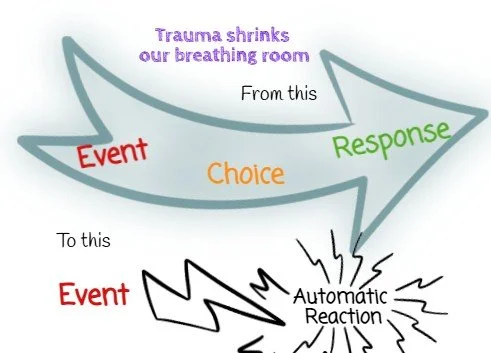
Before we dive into learning how to take on different roles, let's talk about something important: how trauma affects the ability to pause and choose responses.
Think about trauma as something that squeezes out the breathing room between when something happens and how you react to it. When you’ve experienced trauma, especially during your formative years or repeatedly, your brain gets really good at one thing, keeping us safe! But this comes with a cost.
Instead of having that moment to think "hmm, how do I want to handle this?", you jump straight into reaction mode. It's like your brain's autopilot kicks in before you even realise what's happening.
In healthy situations, you develop what one might call a "response pause button" - that little moment where you can consider your options. Trauma tends to disable this pause button. Rather than responding from a place of choice, you react from patterns that your nervous system learned would keep you safe.
These automatic reactions often show up through default role collections. That Acting-Out Child role collection might pop up instantly in situations that even slightly remind you of past difficult experiences. What looks like an action you’re playing is actually your body and mind trying to protect you - it's reaction, not action.
The good news is that healing involves gradually rebuilding this space. As you practice feeling safe and regulated, you can stretch out that gap between what happens and how you respond. This creates room for choice again, allowing you to move from automatic reactions to thoughtful actions.
When you learn to get comfortable in this space between trigger and response, you gain the freedom to pick from your role collection intentionally, rather than being driven by old patterns. This ability to choose is the foundation for the role development work we'll explore next.
As we start to understand how trauma affects our role collections and responses, here's something really encouraging: just becoming aware of our patterns can create powerful changes! Dr. Gabor Maté touches on this in "The Myth of Normal" – sometimes simply recognising what's happening is enough to start shifting things, without needing years of intensive therapy. When we notice how trauma has squeezed out that breathing room between something happening and how we react, that very noticing starts to create more space. It's like turning on a light in a dark room – suddenly we can see what's there.
When we catch ourselves thinking, "Oh, that's my old pattern kicking in," we've already created a tiny moment of choice that wasn't there before. This doesn't mean deeper healing work isn't helpful – it absolutely can be! – but it's reassuring to know that even these small "aha" moments can create real changes in how we interact with ourselves and others. As you continue reading about different roles, remember that the awareness you’re building right now is already part of your healing journey. Noticing is the first step to choosing differently.
Here are the references for you to look more deeply into this if you want to:
Thompson V. 2014 Reflections on Role Theory. AANZPA Journal (23)
Maté, G., & Maté, D. (2025). The myth of normal: Trauma, illness & healing in a toxic culture. Vintage Canada.
Against, Towards or Away From - Our Survival Actions
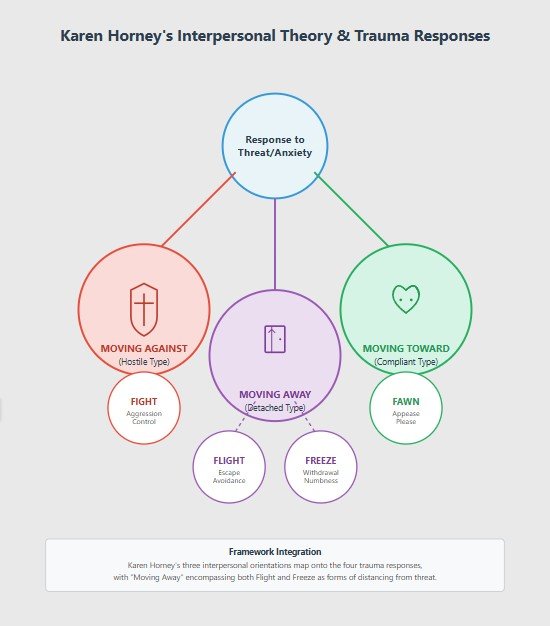
When under stress, we all fall back on survival actions, to protect ourselves and our values. Our survival actions show a general tendency; we either move against, towards, or away from others. Karen Horney (pronounced Hor-nay) lived in the late 1800s and early 1900s. She rocked the psychoanalytic world of her time because she could not agree with Freud’s theories, which were prevalent then. She showed how culture and interpersonal relationships determine, to a large extent, how we act. Horney writes about three interpersonal trends in two of her books: to move against others, towards them, or away from them. Horney believed that basic anxiety, brought about by insecurities, makes us who we are. We need the anxiety and insecurities to shape us. We also need them to keep us safe. In a home with no trauma of an adult dependent on substances or processes, a child can use all three methods of protection. They learn which one works best in what situation: against, towards, or away from. In a traumatised home though, after a while, one will become the favourite and the others will be runners up. By the time we are adults, we have found the one that works best and use it almost exclusively.
My own survival style is to move towards others; make it better, make them like me. I find this very easy and a successful method. The problem with this is that my own needs, wants and desires come second. My second survival style is to withdraw (away from) others. “Fine. I’ll go be by myself then if you don’t want me”. My least favourite way of survival is to confront (move against) others. I’ll only do that if I am secure in the relationship.
If we want to put this into trauma response language we would say that moving against could be called the fight response, moving toward could be called the fawn response and moving away cold be the same as flight and freeze, which are both ways of detaching.
Actions taken from the role collection change depending on the people around us at the time. It is ok to make jokes at a party, but generally not at a funeral. Or it may be, depending on the people who are there. It is ok to inspect the ranks if you are a drill sergeant. It is generally not ok to inspect the children when you get home. If you do this, we could say that you are using an action from the collection of Family Hero: ‘driven perfectionist’. This may be one that you fall back on in most situations.
In this next action we are going to only work in the moment; in our client’s current relationships. We are not going to look at the past, even though the past is where they have come from. It is today that we are going to change. They will describe themselves in a systematic way. They will observe and analyse their responses in a thoughtful manner. They are kind to ourselves. They will show compassion. They don’t judge (and neither do we). They want to see and grow the health in their role collection rather than focus on the dysfunction.
It is important to recognise that all actions have an origin; a starting place. They acted that way the first time in response to something that happened, and it worked, so they kept on doing it. Good news is, they don’t have to stay in that place any longer. They can practice the actions from any other collection, just like a child would in a family with no trauma caused by a family member dependent on substances or processes.
In everyday life, we want to use the role collections to our advantage. Take the good from all the role collections to live in a healthier and happier way.
Here are the references for the information about this:
Horney, K. 2014. Neurosis and human growth. Place of publication not identified: Routledge.
Horney, K. 2014. Our inner conflicts: a constructive theory of neurosis. Oxfordshire: New York, NY.

Discover Your Roles in Action
Think about your past week. You got up, and did whatever it is you do to get ready in the morning. You went to work or school or whatever it is you do all day. You spoke to people, you worked with people, you shopped. You ate and drank, you enjoyed leisure activities, or you didn’t. There was weather, it was sunny or rainy or foggy or whatever it happened to be.
Time to brainstorm. Use the worksheet to write down the names of people you interacted with over the last few days. Or last week, if you can manage it. You can use code names if you want to maintain privacy. Then write down the main actions you can think of that they were taking on. You could list them or use arrows if that’s how you work best. If it was a longer encounter, there could be many actions from many collections. Did how you act depend a little on the other person? Or a lot? Could you see how much you affected the other person by the way you talked, acted, stood? By your facial expression and tone of voice? Do you seem to have certain patterns of interactions with some people? Can you see how this ties in with the trauma role collections?
You may need to go back to the worksheet from the last action where you discovered your way of being – Hero, Mascot, Lost Child, Scapegoat – to compare.
Here’s a short exchange between two sisters as an example of how to approach this action.
Mary meets Stephanie at a café with some exciting news: she is getting a promotion at work. She’s worked hard and did everything right, and is finally getting recognition. The promotion means a salary raise as well as a car and an office to herself. She is out of her mind with excitement, and wants to share it with Steph.
“Hey, I have news!” she says. She can’t keep the excitement out of her voice and she has a huge smile on her face.
“What is it?” Steph says, not looking up from her phone and frowning at it.
Mary can see how stressed Steph is and wants her to be ok. She also wants to share her news. This is a familiar conflict. She says “Um, Steph this is important,” feeling a little sick as she hears the pleading in her voice.
Steph retorts “What!? I’m listening!” She sounds irritated as though Mary is interrupting something important.
Mary sighs. She knows yet again that Steph has zero interest in her news. She keeps the anger to herself and says “Never mind, I’ll tell you when you aren’t so busy.” Steph glances up then turns back to her phone.
Mary sits and drinks her coffee alone, even though her sister is sitting right there.
This is how Mary and Steph act with each other. I would say that Mary is acting out a well-worn action from the Placater/Mascot role collection. She makes sure Steph is ok, even though it means she can’t share her news.
You don’t need to scrutinise every single interaction with every single person. Just take a short exchange and use it. How did you interact? Were the actions different from your feelings? Were they the same? It will be helpful in the coming worksheets to have more than one, so I’ve included two worksheets, just do as many as you can. When you have done at least two or three, use the summary page to list all the actions, be sure to include the feelings that went with them.
Surviving or Thriving
Once you have identified some feelings and the associated actions, you are going to categorise them. In the example of Steph and her sister, I would categorise the feelings/actions she took on in that context as ‘surviving’. Steph shut down from the impatience.
To help you categorise the feelings/actions, write a little S next to the surviving feelings/actions, and a little T next to the thriving feelings/actions. You can colour them in if you want to, or use little symbols. Whatever makes sense to you. When You’ve done this, you should have two categories of feelings/actions with at least one feeling/action in each category. One of the categories will be larger than the other. This is normal.
Your automatic survival reactions are like little signposts pointing to where the trauma lives! Think of these reactions as breadcrumbs that can lead you back to what needs healing. When you notice yourself jumping quickly into a particular action from your collection – maybe becoming the "strong group leader" or the "stress absorber" without even thinking about it – that's your body and mind showing them exactly where you learned to protect yourself.
These quick reactions are actually valuable messages, not problems to be fixed. They're like your inner wisdom saying, "Hey, pay attention here!" When you find yourself reacting strongly or automatically in certain situations, it's like your system is highlighting the spots that still carry those old hurts or fears. It's actually pretty amazing when you think about it – your body remembers and is trying to keep you safe in the best way it knows how.
Getting curious about these automatic responses instead of judging them gives you a compassionate map to your healing.
Each time you catch yourself in an automatic response, you can gently ask, "What's this trying to protect me from?" The answer often reveals exactly where your healing journey wants to take you next. These patterns aren't mistakes – they're messengers with important information about what parts of you are still waiting to be seen and understood.
You might not think that you have any thriving feelings/actions. Remember that a thriving feeling/action is one that helps you to get what you need in a healthy way. It helps you express yourself so others understand you. I’m not talking about over-explaining, which is not generally a thriving feeling/action because of what drives it – the need to be heard.
Your surviving feeling/action list, on the other hand, may have more in it than the other. Pat yourself on the back; this is how you got to where you are today. You’re alive. Others didn’t make it through. You can read. Others cannot. You want life to be better. Others aren’t at that stage yet. You have a lot to congratulate yourself for.

Moving Towards, Away From or Against
We are also going to break down the surviving group into three further groups. Remember that these are the things you do when times get tough; when you feel under pressure. Sometimes it may be appropriate to do any of the following three; disregard those times. We are only interested in the cases you do it as a reflex when you are under pressure. Break down the actions in the surviving group into the following categories. Write them down on the worksheet.
Moving towards people, get them on your side, give them what they want, be all things to all people
Moving away from people, withdrawing into yourself, tuning out, physically leaving
Moving against people, being hot tempered, hard to talk to, take offence easily
I know this is complex, but please be patient. When you are finished it will make sense. This exercise will show you which feelings/actions from your repertoire are working for you. These are your thriving actions. You also need to look at which actions are not working for you; actions that cause conflict and confusion: survival actions. Looking at your survival actions, you need to consider whether they are still working for you, or are causing pain to others and yourself. The main thing to remember here is that all actions exist, or have the potential to exist, in all people. The different actions carry varying degrees of strength, depending on how often you use them, just like muscles. This is an important concept. Anyone can be a kind teacher or a reluctant learner. Anyone can be a strident ruler or penitent slave. You can be a fearless leader any time you want to. You can learn different actions from any of the roles (Mascot, Scapegoat, Hero, Lost Child), and the more you practice them, the easier it will be to use them. Sounds simple, doesn’t it? The purpose of this action is to get you thinking and observing how we affect each other. By becoming more aware of this, and by practising, you will have a much larger pool of resources to draw on.
The good news is that you don’t have to rely on your reflexive survival responses any more. You don’t have to remain stuck in the dominant aspects of the Hero role or the Lost Child role. We are all people, and we can grow in our self-awareness. We can change our behaviour.

Healing Intervention
-
This ceremony is a sacred moment of commitment to personal and family healing. It is a powerful acknowledgment of your journey of self-discovery and your courage to create positive change.
-
Take a deep breath and hold space for yourself. Remember healing is a gentle, gradual process. You are not required to transform overnight, but to take small, intentional steps.
-
You commit to:
Observe your own actions with compassion
Focus on one action at a time
Be patient with your growth
Understand that change is a journey, not a destination
-
Your journal is a trusted companion in this process. After each interaction, take a moment to:
Reflect on what happened
Identify your initial reaction
Imagine alternative responses
Write down your insights without judgment
-
Remember that:
It's okay to feel uncomfortable as you uncover new patterns
Every moment of awareness is a victory
You are learning, not failing
Your family system will naturally shift as you shift
“I am capable of growth. I am learning new ways of being. I am worthy of compassion, especially from myself.”
Closing Meditation
Read this out loud then close your eyes and
Visualise yourself growing, changing, expanding
See yourself responding to challenges with newfound wisdom
Know that you are supported in this journey
“I am not alone, I am brave, I am becoming.”
Optional Reading
Before I knew anything about family roles, I tried to capture my ideas about the way I was. I needed to get my ideas out of my head and onto paper. I imagined a family of girls living within me that I could call upon when I needed them.
My Girls and Their Mother
I am Defender. I was born when my body was very little amidst giggles and whispers of ‘don't tell’. At first I was weak, for I was very little. Each time my body was invaded I became stronger, until now I am as strong as I will ever be. Every unwanted leer, unwanted touch, uneasy feeling calls me forth. Each time I am called I respond willingly, knowing that I become stronger and more determined to defend this body to my death.
I am Peacekeeper. I was born when my body first felt the sting of cruel words and jeering laughter. I yearn for peace. I will do whatever it takes to restore my body to the slowed heartbeat, the quietness of mind that comes from knowing I am safe. I have no rights, for I am always wrong if that's what it takes for peace. I am ever on call to still the tongue, soothe the thoughts, deepen the breath, and like my sister Defender, will respond willingly even to my death.
I am Lover. I came into the world when my body noticed others and the loneliness that came from difference. I strive to fit in, to be the same, even knowing as I do this that I sacrifice the beauty of diversity. I will be anyone, say anything, entertain you, enchant you, flatter you, be like you so you will not notice my body's emptiness. I am ever alert watching you, learning you. Sometimes Peacekeeper works with me, for our body calls us both and we fit together like tendrils of a sweet-pea. We are ever tireless, helping our body to survive in a loveless world.
I will tell you of the smallest of us, the most vulnerable, paralysed with fear, Little No-Voice. She is frozen in time and cannot talk or even breathe. She lives in the time when a big big man who should have known better, harshly demanded with violence an answer she could not give to a question she could not understand. She is small, so small, gentle, innocent, helpless. It is easy to overlook her. Still she communicates in the only way she knows how, freezing my body's mind. It has taken too long to see her, to love her, to give her the safe place that frees her from the ice that she becomes. This little one will ever be with us, and needs our strength and voice until she can speak for herself.
They call me Actionmaster, although I prefer to be called my proper name, Perfection. I am different from the other girls as I was not born of the body, but given to her by others outside of the body. She was little and very clever, and others did not like that. Even though others gave me to her, she adopted me as her own. She called upon me but as my strength grew, she called upon me less and less. That did not matter, for I now come even when I am not called for. I am very strong. My nemesis is Creator, who I call Chaos, and we are ever at battle with one another. I will win.
I am Creator. I have always been with my body, and she would die without me. I must express her very selfness. She struggles with me and the beauty we create together. Actionmaster is always there, belittling her efforts, making her feel small and inept. She has moments of freedom when the thing we have created matches the image in her mind, but these are rare. Actionmaster is more often there with cutting words, asking why this seam is crooked or why that tile is raised up more. She points out many other imperfections. She makes my body dissatisfied as though she should have been born knowing how to do everything perfectly. In these times, she feels discouraged and small and gives up, surrendering to the cruelty. I wait until she is at rest, and then I whisper in her ear of the beauty of the world and the stories that flow through it. The colours and textures and wildness and unlimited, untameable, marvelous, wondrous mind.
I am the body. I house all these girls and call upon them unthinkingly, born of habit. When a word, a look, a feeling comes upon me, I call and I call for I need them to sustain me. They have been with me always and I hope, will always be. I go about my day, my week, my life passing me by. I have had unsatisfactory lovers in my time. Fleeting, each one like a boat that bobs up against mine, then is pulled away by the waves and the tide to leave me alone. The lover I have now is gentle yet strong, flawed yet confident in her perfection and our love is strong. I have children, mysteries to me, unreachable, unknowable, unfathomable. What are they thinking and feeling? I was determined to give them what I never had, but unwittingly taught them all I knew.
A change is coming over me. I have begun to feel different. I have become older, wiser; half a century of years have passed me by. It is no longer satisfactory to me to have all these girls to call upon, I wish to be myself. Me. I have birthed a new girl, Haakui; Mother. She is part of me, born of my need. Wise friends were the midwives that birthed her. I am the one that nurtures her, calls upon her, gives her strength to soothe the girls and give them rest.
Confusion arises. I take a deep breath. I call upon Haakui to help me show Defender, Peacekeeper and Lover a different way, now that I am no longer small. I am becoming stronger and more adept at recognising when I used to call upon my little girls. My hope is that they will be at peace and no longer need to come to me in the way that they have done. Haakui is strengthening Creator, Peace, Serenity, Joy, Strength and Security. She strengthens Little No-Voice.