

Neutralising Hidden Family Rules - Part 1

Rules are what keeps any society going. We need rules. Even in a family there are rules. In a family with trauma there are rules that become less about life and more about survival. This element has only two actions. I won’t lie to you, they are hard. The effects of the trauma have made your client unfeeling, untrusting and silent. But they are not alone. You are there to help them through it. You can do it together. Together, you can undo the effects by feeling, trusting and speaking out.
In the first action you are going to uncover the hidden rules that were established in your client’s family. You are then going to examine these rules that continue to bind the trauma effects around them ever tighter. It’s not enough to know what they are. They are going to grieve for the life they might have had, and then let that resentment and grief go.
In any group, there are unspoken rules or norms. For example, a new workplace is a minefield of unspoken rules. Social etiquette exists to ensure the smooth running of any group. It is human nature to reward certain behaviours that we call ‘politeness’ and ‘manners’. We like people who follow the rules. It makes us feel safe. If you go to a different country, you have to learn a whole new set of societal rules. Even if you simply attend a gathering of a different ethnicity, you will see many things that are strange to you, but normal to them. Ask any immigrant about what the hardest thing is about moving to a new country, and they will say fitting in. We need rules to function as a society. We know instinctively what the rules are, as we have grown up with them. We don’t need to think about how to queue in a shop, or who goes first in an elevator. We know how to make small talk at the checkout, and what is OK to talk about. Our unspoken rules become obvious only when others break them. Or when we break them.
A family is a micro-society that has its own unspoken rules. This is Dad’s chair, you’d better not sit in it. If you feel sad, you can talk to Mum. Someone will always tuck you in at night. You will stay in school. You will stay home to help Mum with the little kids because she can’t do it alone. You will not break laws. If you finish your dinner you can have some dessert. If there is no dinner, find something to eat. When Dad is late, Mum gets upset so you go to bed early. If Mum has been drinking, anything can happen. First up, best dressed. These rules ensure the smooth running of a family unit. You don’t have to think about them, they just happen. I’m sure you can come up with a few examples of your own in your family of origin and the family that you have created. In a family with trauma, especially , the rules are more about survival at a different level.
One of our family rules, and one that is common to all families with people who are struggling with compulsions, is ‘Don’t speak’. This course is hard for me to write. I’m immediately caught up in the rules. I’m going against 60 years of training. Don’t speak about how Mum was so drunk she couldn’t cook dinner. How I didn’t have any clean clothes because no-one did the washing. How no-one wanted to sit next to me at school because I smelled. How I had to leave town in a hurry because Mum was in danger. How scared I was hiding under the seats of the train at night so his friends wouldn’t see us. My family and I have never talked about it. Now as I’m writing this, I can remember many other times when traumatic events happened. And still, we have never ever talked about them. The biggest thing that my three siblings and I did not talk about, was the fact that Mum had a drinking problem.
Another family rule common to our family and all families with compulsive behaviors is ‘Don’t trust anyone’. A child from a family with this trauma learns early on that they can only count on themselves. This is true of me too. I learned at quite a young age that no-one was going to help me. The only person who can keep me safe is myself. Keep watch. Be on guard; you never know when a fight is going to break out. Don’t worry about making friends, because I’m not going to be here long. I went to six schools before I was eight. I couldn’t trust adults to keep me safe. At ten, I was a dirty little creature who once told a priest that “I am the only one in the family who hasn’t been drunk”. When reflecting on that little girl, I want to hug her so tight. And the result of this mistrust? Intense, deep loneliness that permeates every aspect of my being. Separation. A burden too heavy for a child. A burden too heavy for an adult.
The final big family rule that is the third in the trio of ties that bind you, is ‘Don’t feel’. This is the rule that you are going to counter today. Children do whatever they can to bring stability and consistency into their lives. If this means shutting off feelings to get through the day, that’s what they do. Because they can’t talk with or trust anyone, they must rely on their feelings alone. It doesn’t take long to become overwhelmed and shut down. It is normal to feel many feelings in the course of a day or even an hour! When big events happen to a child, it would be normal for them to have feelings like fear and sorrow. You would expect them to feel angry, embarrassed, or guilty. The child of a home with addictive behaviours learns to feel nothing at all.
I became really good at suppressing my emotions and ignoring everything I didn’t want to see. I opted out. Books became my friends. I remember sitting in a classroom as a child, reading. A group of children gathered in front of me watching me. They would laugh whenever I twitched my nose. I was aware of them, but I didn’t care. As a child, I spent many hours on the porch or in a tree reading about all my friends, Alice, Katie, Tarzan, Pooh, Anne, and Jo March. Words kept me safe. The problem with suppressing feelings is that sooner or later they leak out. And you can’t control the leakage.
Educational Insight - Awakening Feelings
Why do we have feelings?
As a child of a family with the trauma of compulsive behaviours like excessive drinking, a huge part protecting yourself is to shut down your feelings. You have lived like this for most of your lives, but you can get to know yourself better. You can stop reacting and start acting; start taking responsibility for yourself. In this action, you are going to use your subconscious world to build up your conscious world. It’s hard. It’s much easier for you to deal with what you can see than what you can’t see. We can’t see our thoughts and feelings or our spirit and soul, so we ignore them. Emotions are a part of our health and we have a responsibility to manage them as much as we do their physical body. Remembering that trauma shrinks the breathing room between something happening to us and how we respond to it. Instead of having space to choose our reaction, we find ourselves automatically responding based on old protective patterns. That snap reaction - whether it's shutting down, lashing out, or people-pleasing - is often our younger traumatised self trying to stay safe.
With great responsibility comes great power.
Emotions alert us to something deep in our memories. Dr. Candace Pert was a widely published pharmacologist who is internationally recognised for her pioneering work on peptides and their receptors.
Pert says that ignoring our emotions is Western culture ‘oldthink’ . It’s left over from when we didn’t know that our bodies are physical, emotional and spiritual. Each aspect is important, and they influence each other. Science has now caught up with what the Eastern cultures already knew thousands of years ago. Emotions are key because they allow us to enter into the body-mind’s conversation. By getting in touch with their emotions, you allow the healing wisdom of your own body. Your physical and emotional bodies intertwine and you cannot separate them. Your mind and emotions affect your body, and your body affects your mind and emotions. If you have a sore back you feel grouchy. If you feel stressed you hunch their shoulders. If you can learn to listen to your emotions, you can get a better handle on what is happening in your body, and vice-versa.
The difference between feelings and judgements
Feelings are elusive little creatures that live in your head and body. They are hard to pin down. Sometimes we say “I feel like…” when we are really saying “I think that…”. For example, “I feel like it was last Thursday.” But last Thursday is not a feeling. “I feel fat”. Fat is also not a feeling. “I feel intimidated”. That’s not a feeling, it’s just your judgement of how someone is treating you. It would be correct to say “I feel nervous or unsure”. Until we get this distinction right, we will continue to confuse our feelings with our thoughts. When you name your feelings and don’t blame others for giving them to you, you are taking your power back. You are owning your own feelings. They are your feelings, others can’t give them to you.
The first thing you need to do is acknowledge and claim all of your feelings. Not only the ‘positive’ ones. You need the ‘negative’ feelings also. Anger, grief, fear, these emotional experiences are not negative in themselves. They are part of you, and you need them as much as the positive feelings. Anger shows injustices in your life. You need grief to deal with your losses, otherwise, you would be a big sad ol’ bundle of loss and pain that never goes away. We’ve all met people like that, and they’re uncomfortable to be around. Pain is going to come out whether they like it or not. Bottling it up to save for later to stroke it like Gollum, does not work. Trust me. We also need fear to protect ourselves from danger.
Even if you think feelings are not acceptable, it’s vital for you to express them and then let them go. If you don’t have a safe place to do this, I encourage you to go and be alone somewhere, or write about it in your healing mantra. It takes a long time and a lot of therapy to be able to feel feelings, name them, and be ok with them. Not only the easy ones, like happy and angry.
For me, the difficult emotions are disappointment and tension. I’ve discovered amazing women who have helped me be at ease with these emotions, like Pema Chodron, Brene Brown, Szifra Birke, and Kathy Mayer.
Often your client might think that it seems like emotions come out of nowhere to mess with them, almost like emotions have lives of their own. They have to learn how to recognise emotions so that they can understand what sets them off, and also how to read them.
Over the years, psychologists have categorised emotions so that we can put a name to what we’re feeling. The idea of basic or primary emotions first came about in the Book of Rites, a first-century Chinese encyclopedia that identifies seven ‘feelings of men’. It categorises emotions into joy, anger, sadness, fear, love, disliking, and liking. In more modern times, Paul Ekman identified seven basic emotions. These are anger, contempt, disgust, fear, happiness, sadness, and surprise. Robert Plutchik identified eight, which he grouped into four pairs of polar opposites: joy-sadness, anger-fear, trust-distrust, and surprise-anticipation.
Basic emotions evolved in humans in response to our ancestors’ everyday problems. Our primitive brain is hard-wired with them. Each of the basic emotions has a distinct and dedicated neurological circuit. Because they are hard-wired and designed for survival, they are automatic and lightning fast.

The Emotion Cycle

More complex emotions are more difficult to trace back to basic emotions. But whether the emotions you feel are complex or basic, they all go through the same cycle:
there is an event
thoughts come into your mind related to the event
there is a physical response: a feeling is born
you want to act
you act
the fallout
which can be a whole new event that starts another emotion cycle.
Sometimes the emotion cycle (thoughts influencing feelings that influence actions) can actually feel as though you are on a carousel. You go round and round and round and round, feeling sicker and sicker and getting nowhere.
Two different people may experience the same event, yet have different reactions. The emotion cycle will be different for each of them. Take the following scenario, for example. Read through the two passages and ask them to notice how they feel while reading them. For added effect, ask them to take a deep breath and hold it while you are reading the first scenario:
Maria walks down a dark alley at night, taking a shortcut home. Her thoughts turn to all those stories and TV shows where someone attacks someone else in an alley. She is running scenarios through her mind of someone maiming, raping or killing her. She calls herself an idiot for taking this shortcut. She feels petrified. She is on high alert, prepared for danger. Her pupils dilate and her hearing is better than usual; her head is constantly turning so she can scan the alley. Her legs and arms are pumped full of blood, ready for action. Her digestive system has stopped. Her body has stopped all functions that are not in immediate service of saving her life. She holds her breath. She want to start running to get the hell out of there
ShewalksfasterthenevenfasterthenthankGodshecanseetheendofthealleyandherstreet.Once she is in her familiar street, she lets out a big breath (you can breathe now). She vows never to do something so stupid and scary again. The next time she walks home alone, she will avoid the alley.
On the same night in the same city, Josephine is walking through another alley. She is also taking a shortcut home. The alley she is walking through is dark and smells funny. Josephine is a black belt karate champion. She knows she can handle herself if anything happens. She feels a prick of fear in the back of her mind, and she runs through scenarios in her head. She remembers that she has beaten others when she needed to protect herself. She has walked down this alley many times with no trouble. She walks as normal, breathing deeply and evenly. She stays alert to danger while not expecting to meet anyone; she never has before. She sees the end of the alley and her street, and carries on walking.
Maria and Josephine are in the same situation but experience different emotional responses. Based on past memories, their thoughts strengthen their feelings.
My story
I spent a big part of my life not feeling, because it was easier that way. Learning to feel emotions is hard. I was OK at feeling anger and joy, but other emotions were elusive to me. To help me become more aware of my feelings, I kept a feelings diary. It started off pretty simple. My first entry was ‘I felt angry. Someone cut me off in traffic.’ It was important to me to link the feelings to the action that had caused it. This ensured that I wouldn't blow up at my long-suffering partner for nothing because I was still mad about something else.
You are children of family dysfunction who has learned to repress and deny your feelings, and this is actually hurting your brain. When denial or trauma blocks emotions, blood flow in your brain becomes constricted. This deprives the frontal cortex of oxygen. You need the frontal cortex, as this is where all your processing for motor functions takes place. It is the seat of problem solving and spontaneity. Memory, language, judgement and impulse control, and determinants for social and sexual behaviour take place here. Pretty much your whole existence and how you relate to other people is determined in the frontal cortex.
Denial or trauma can also cause you other organs to become starved of vital nourishment. This can leave you foggy and less alert. All this, simply from denying emotions. Amazing.
Imagine your body is a village. All the villagers depend on each other for survival. Wouldn’t you want the village to be at its best? If it isn’t, it will have no defences against a hostile takeover bid by another village or country. Not being properly in touch with their brain and other organs means that you can’t hear your body when it talks to you. You ignore those stomach pains, or feelings of fear when you’re in a dark car park. You let others take advantage of you until one day you SNAP! You can’t make decisions for change and as a result, you may become stuck in a time warp. You are unable to respond to the world around you. You keep repeating old patterns of behaviour. You are feeling feelings in response to an outdated database.
The solution to this problem is to learn new responses to old situations. You can release yourself from these blocks caused by trauma and denial. Later in this session, we are going to learn how to do this when we make new rules to guide us in our emotions. The first action is a simple, fun way to become more aware of your feelings. Dr. Candace Pert advises the following methods to help you achieve awareness:
Please be aware that if the blockages are of very long standing, you may need help in achieving such awareness, help that may come in many different forms. I would include among them psychological counselling, hypnotherapy, touch therapies, personal-growth seminars, meditation, and prayer. Any or all of these can teach you to respond to what is actually happening in the present, which is in large part what consciousness is all about.
Reflective Discovery - Learning to Feel
Use the worksheet in the book to identify your feelings throughout the day. Use this feelings worksheet as often as you need to. One option to make it easier when you are starting out, is to concentrate on one feeling and track that one only. Remember that you have had trauma put upon you; this was not of your doing. You did not choose this, but it is up to you learn how to undo the trauma effects you suffered. You are the only one that can do this.
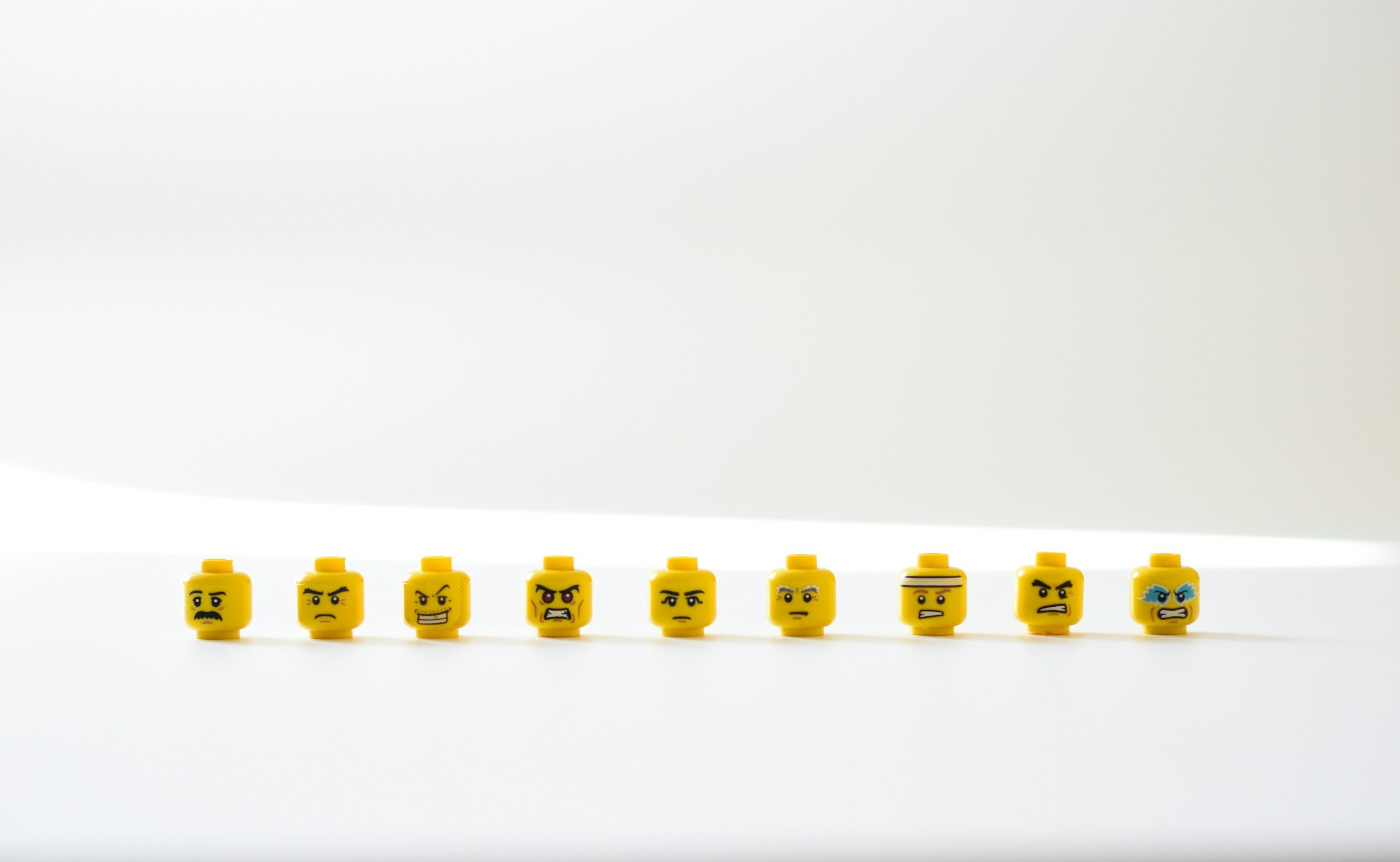
Learning to regulate yourself is a very powerful part of changing the effects of trauma. The more you do this, the weaker the original trauma effects will become. Emotions are inconvenient at times, but are so important. They:
are much quicker at processing a situation than our brains are
prepare the body for immediate action; we call them e-motions for a reason! (see what I did there?)
influence our thoughts and give us meaning
help us to motivate our behaviour in the future.
Emotions are social fuel. All of society runs on emotions. From the smallest family unit to the largest corporation, everyone needs emotions to help others know how to behave around us. Interacting through feelings puts other people at ease. When others can recognise what is happening with you, they can respond appropriately. For example, anger evokes fear or more anger. If you look sad, others may react with empathy or sympathy to make you feel better. Emotional expressions also give us clues about how others feel about us. Are they smiling or frowning? Do they seem happy to see me, or not even notice if I’m there?
We are constantly walking the tightrope of expressing ourselves and fitting in. Am I too loud? Am I too quiet? I want to laugh out loud, but no-one else is. And we’ve all made mistakes; I know I’ve laughed a little bit too long and loud at inopportune moments!
Emotional Regulation
Remember that trauma shrinks the breathing room between something happening to us and how we respond to it. Instead of having space to choose our reaction, we find ourselves automatically responding based on old protective patterns. That snap reaction - whether it's shutting down, lashing out, or people-pleasing - is often our younger traumatised self trying to stay safe.
Emotional regulation is a way of controlling ourselves. It is a vital part of your wellbeing. When you are aware of yourself you are less likely to blow up, explode, or act in unpredictable ways. You are calm and confident. You don’t make others uncomfortable; if others find you unpredictable, it could lead to avoidance and exclusion. Your survival would be at risk. In ancient times, this was manifested in physical exclusion, but in modern times it’s more about emotional exclusion.
Catch, Check and Change
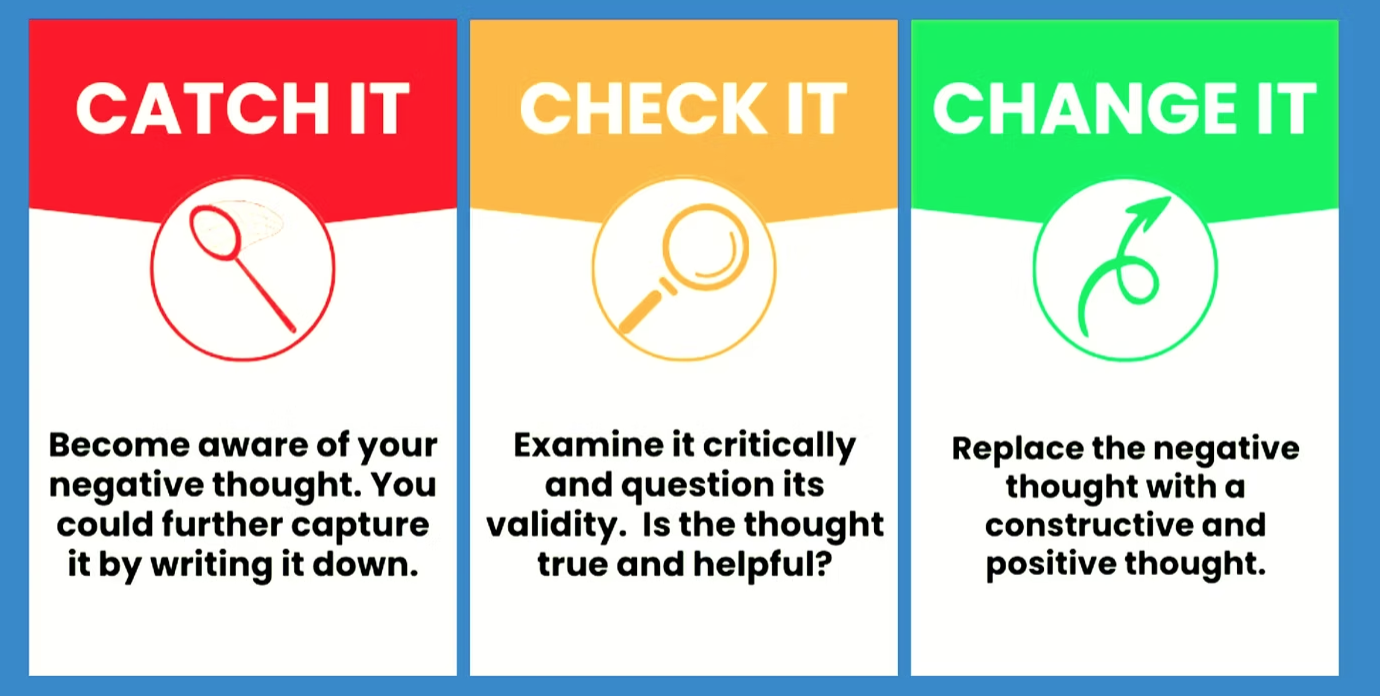
When something unpleasant happens to us, we usually feel angry, disappointed, or anxious. We can use the ‘catch, check and change process’ (a principle of Cognitive Behavioural Therapy or CBT) to determine if we needed to feel this way or are misinterpreting the situation. During the catch and question process:
We slow down and catch and question the first thought
We gain evidence for and against it
We can see if the thought is actually factual or not.
Here’s the good news. If there is one shred of evidence against that first thought, IT’S NOT TRUE. Let me repeat that. If there is one teeny-weeny, itty-bitty whiff of evidence against it, it’s not factual. In which case, we can stop angsting about it (the unhelpful spiral downwards) and do something else. Sound too good to be true? It is pretty simple, and what’s more, IT WORKS. Consider the following example:
The Unhelpful Spiral Downwards
When I went to my business networking group this morning I saw John – we’re best buds in the group – and smiled at him. He looked at me and turned away. My first thought was “Oh no, what have I done to upset him?”. I felt anxious and sick. When someone else came to talk with me later I was preoccupied and couldn’t really talk to them. I was anxious and nervous, and preoccupied about upsetting John. I’ve been stewing about it all day. Going over and over it and wondering what I did wrong. I still feel sick and it’s 7 pm.
The Catch, Check and Change Approach
When I went to my business networking group this morning I saw John – we’re best buds in the group – and smiled at him. He looked at me and turned away. My first thought was “Oh no, what have I done to upset him?”. Then I caught the thought and questioned it: “The evidence for it is that he seemed to look at me and turn away. The evidence against it is that last time we spoke things were OK. I haven’t done anything to upset him. It’s a dim room, it’s possible he didn’t actually see me. He was talking to Steve at the time. He may have been concentrating on what Steve was saying”. So because there is evidence against the thought, it’s not a fact. I went back to my original thought and replaced it with a new factual thought: “I haven’t upset him, he’s busy.” I felt puzzled, and decided to catch up with him later.
In using the catch and question approach, my relationship with John stays intact. My peace of mind stays intact. In fact, no-one was harmed in the making of this scenario. Now it’s your turn.
Use the worksheet in the book over the next few days then come back to learn about dream stories.
Copy as many worksheets as you need and work with them until it becomes second nature. You could also look at the worksheet and use your journal to make notes about what happened. I want you to take notice of an incident or time when you feel uneasy, anxious or upset, and write about it. The incident can be as small or large as you like; remember that nothing is unimportant. Also remember that you are not to judge yourself. These emotional reactions are based in the past and they developed for a good reason. They were part of the trauma effects that we are breaking. But they are now out of date, and we’re going to update them. The scenario below illustrates how to approach the worksheet that follows.
Tears flowed down Dawn’s cheeks. “I think I did the right thing by breaking up with my girlfriend for good this time, but now I’m not sure. I went and saw her yesterday and we hooked up. Now I keep wondering if I have done everything that I can.”
We talked for a while about the relationship and why Dawn ended it. “She wasn’t interested in moving in with me and my kid, she made that pretty clear. In fact, she doesn’t even like my kid. But when I saw her yesterday she said that she could stay one night a week with me and the kid. She wants us to stay together. Now I’m really confused. Is she changing? Should I wait for her to change? It’s already been two years. I want more, I want someone who loves my kid and wants to be with me as a family all the time.”
We decided to use the worksheet to help clarify Dawn’s feelings. She wrote out the event: “Girlfriend said she would come and stay one night a week.” She wrote out her first thought: “Yay she wants to be with me and the kid.” She then wrote out the evidence that this thought was true: “Gf said it, I heard it.” Then she wrote the evidence that it was false: “It’s been two years and no change. She doesn’t even like my kid. I’ve had to separate my mother-self from my girlfriend-self and I’m sick of it. She’s had plenty of time to change. I’ve given her three second chances; she’s not going to change”. The shiny new thought based on fact is: “Gf is not going to change. I need someone who loves the whole of me and who loves my kid.” The new feeling based on that fact is determination. The sparkly new action based on the new feeling is to stay strong and cut all ties after explaining why to the other person.
Dawn gave me a watery smile. “I can do this! It helps to see it in writing, and I can go back to it any time I want”.

Educational Insight - Dream Stories
Dr. Candace says that dreams are direct messages from what she likes to call your ‘bodymind’. Dreams give you valuable information about what’s going on in your mind, as well as with your emotions. It’s like eavesdropping on the conversation that is going on between body and mind. We can access levels of consciousness that are usually beyond our awareness. This is where the magic happens.
Why do we have dreams when we sleep? What is happening when we dream? Different parts of our bodymind are communicating with each other; gossiping like neighbours. We get to hear the gossip in the form of a story, complete with plot and characters using the language of your everyday consciousness. You might dream about someone at work, or your partner, or something that you saw on TV. Dreaming is your psychosomatic network resetting itself each night for the next day. Peptides spill out into your system and bind to receptors. This causes your body to return to normalcy. Information about these readjustments enters your consciousness. This information takes the form of a dream. Since these are the biochemicals of emotion, that dream not only has content, but feeling as well.
As ACoA, we have established that we are good at ignoring or squashing our feelings. Especially the strong ones. But they must go somewhere, so where do they go? Our bodies store them in our cells. At night, some of this stored information bubbles up into consciousness in the form of a dream. Capturing that dream and re-experiencing the emotions can be very healing. What you do with the information is up to you. You can either use it to grow, or you can use it to forgive and let go. Once you make the decision to pay attention to your dreams, they will start to speak to you. You will understand them more over time, with practice. What if you can’t remember your dreams or think you may not even have any? You may find that the act of intending to write them down will help you to become more aware of them. Once you have decided, get ready. Place a pen and notebook by your bedside, or use the next worksheet to help you. Deepak Chopra talks about intention and attention. This is a perfect illustration of what he means. The intention is the decision to capture the dream in writing. The attention is the focus; the readiness to carry out the action created by the intention. In this case, writing down the dream.
Dr. Candace advocates the use of a dream book, and that’s how I jot down my dreams too; thank you, Dr. Candace. I write down the story on the right-hand page and the emotions on the left-hand page. It’s important to get the emotions down, because they are the main point of the dream. We aren’t analysing why you dreamed about the alligator driving Aunt Sally’s new car. We are noticing the feelings you experienced when you were there. Were you jealous? Were you angry? Were you happy? Why was that alligator in the car and why did it drive away? It doesn’t matter, what is important is the feelings you had about the car or the alligator. Or how you felt about the fact that it was driving away.
In the morning when you wake up, stretch, yawn, and reach for your dream book. Write whatever comes to mind, no matter how small of a fragment it is, and try not to filter or edit any of the content. If associations arise—aha! Aunt Sally’s car is the same one my dad had when I was ten!—write them in parentheses. The content is not the main course though. The feelings and emotions you experienced in the dream are.
Always ask yourself what you felt. Always. Include these feelings in the writing. Sometimes the emotions are contrary to the action. You might dream about a tragedy and feel happy. The feeling is the clue. Even if the feelings are disturbing or uncomfortable, it’s vital that you write them down. This is good practice for becoming more aware of your waking emotions and those dream emotions. It’s also good practice to become less judgmental of your own inner processes. Write down any bits of dreams; it doesn’t matter if you don’t remember the whole thing. When I first started my dream book, I would often have a teeny-weeny faint echo of memory to write about. I would end up writing one word, like ‘school’ or ‘forest’ or ‘bullies’. Then on the other side, I would write another couple of words as I remembered the feelings involved. I gradually got better at taking notice. I remembered more, often bringing back whole chunks of the dream. Be sure to write down even the most insignificant-appearing dreams. If you discount a dream that seems boring, you may stop yourself from getting an important message. Often our dreams seem boring because we are protecting ourselves from disturbing content. This is true in real life too. Bored is safer than saying we’re disturbed. Once you write down the boring part, other parts will surface into memory.
Like our emotions and thoughts, our dreams follow the laws of information. They exist on a plane that is beyond time and space.
You now know the secret world of emotions, where emotions live in your body and why they exist. You know how to use them to your advantage, because you can recognise the emotion cycle. You can stop the roundabout and get off any time by using the catch, check and change method. You are able to restore your own peace of mind. You can gaze into the secret world of dreams and listen to yourself at any time.
Next you are going to learn about the second Family Rule - “Don’t Speak”