

Neutralising Hidden Family Rules - Part 2
Educational Insight - Using Your Voice and Trusting
In a family with no trauma caused by those who have substance dependencies, the unspoken rules are generally about how to be a good family member. In a family with this trauma, the rules become more about survival than growing and living. In the previous section, we looked at the rule of ‘don’t feel’. We learned that it’s OK to have feelings. It’s also OK to express them. The next part of the trauma we are going to examine is the entwined rules of ‘don’t trust’ and ‘don’t speak’. These twin rules work together and are powerful, but once you learn what to do, you can break the effects of the trauma. You can learn to trust yourself. You can learn to trust others. You can learn to speak up. The biggest part of breaking the effects of the trauma is uncovering it.
This is my story.
I find it very hard to write these words. Thanks to the effects of the trauma, it’s entrenched in me to not talk, not feel, not trust. As I write, I can’t help but think “it all sounds so dreary, there is no way this would interest you”. I’m also minimising my past; my trauma: “it wasn’t that bad, there were good times.” Then there’s also the voice that says “You can’t trust your memory. You remember breaking your wrist at five, but you don’t remember the lounge being on fire in the same year?” But. I’m going to ignore all these voices, and trust only that one shaky little voice that whispers “You need to tell your story, for your own sake”. Even though it’s the hardest thing I’ve ever done, I’m going to continue to break the effects of the trauma that was put on me
Trust is one of the foundations of society. Our way of life runs on trust. When I buy groceries, I trust that the food inside the boxes is what it says it is. I trust that my car is going to run on the petrol I buy. I trust that others are going to follow the road rules. I trust that I’m going to get paid for the work that I do. I trust that no-one is going to steal my lunch from the fridge. I trust my partner will not laugh at me when I share a deep feeling. It’s hard to define trust; it’s easier to know when it’s lost. We trust others when we want to be part of a group or have a relationship. We will do whatever it takes to keep that relationship going. We are vulnerable, yet we feel safe in the knowledge that someone has our back. When people we trust break the trust we place in them, we withdraw. We don’t want to be sympathetic to them or their cause. If you have been badly hurt in the past, you are likely to be on the lookout for broken trust, and will probably only give the people in your life one chance. Or, you keep on trusting them long after you realise that they are hurting you by breaking that trust, breaking the strands that bind you together. It is easy to hide the broken strands. We can go through the motions, but sooner or later lost trust will show up in a relationship.
How do we build trust? By doing what we said we would do. By being consistent. By backing up our words with actions.
This is my story.
If Mum said “I love you” to me when she was drunk, she didn’t mean it. It was the beer talking. She never said it when she was sober. Her actions didn’t show it, and she didn’t know anything about me as I was growing up. She had her own problems. I couldn’t trust anyone. I couldn’t depend on anyone. They weren’t there for me; I could only depend on myself. No-one told me anything. I didn’t feel safe a lot of the time, and I was alone a lot of the time. I needed Mum to pay attention to me, to listen to me and show that she cared. Instead, if I wanted her I could find her in the kitchen or garage with her bottle and her friends. If we had any celebrations, the bottle was the guest of honour.
I remember going to the beach one time as a child. It was a happy day; we played by the water all day while the adults partied. No-one checked on us, and the worst thing happened. My sister, aged three, got swept out by a big wave. I didn’t know what to do, there was no-one to help. I swam out and grabbed her and pulled her back to shore. I saved her. Looking back logically, I know it probably wasn’t that deep, but she couldn’t stand up. It was scary. We were both shaken and scared. I was five. Mum was drunk. She never knew what had happened. We didn’t tell her; it didn’t occur to us to tell her. We carried on with life as usual. Don’t speak and don’t trust.
I learned early on that I cannot trust anyone but myself. And sometimes I can’t trust myself either. The ‘don’t trust’ rule also included other unspoken rules. “Don’t make friends outside the family”. “Nothing is wrong, everything is fine”. “Do as I say, not as I do”. “You must not be angry or sad”, which sounded like “Stop crying or I’ll give you something to cry about”. People with dependencies manipulate. They need their fix to survive and will do whatever it takes. They are adept at twisting situations to their own benefit wherever possible. They lie, use anger, guilt, urgency, blame and self-pity. They need to keep the status quo so they can keep using or drinking or shopping or gambling. This is the norm of someone in the death grip of substance or other compulsive dependency: denial, lying, and keeping secrets. By definition, this behaviour causes mistrust. Is it any wonder that families of those with dependencies have a problem with trust? Broken promises of the past tell us that trusting someone will backfire on us sooner or later.
Another major strand of the trauma of the family with dependencies is the potent rule of “don’t speak.” This means don’t talk about the weird stuff that is happening in the family. It also means don’t talk about yourself and what is happening to you. Don’t ask for help. Don’t ask for what you need. You must not let anyone know about the state of the house. This means you cannot have friends come over. You especially must not let anyone know that Mum spends most of her time in the garage getting drunk. People must have known that things at home weren’t good, but no-one talked about it. They didn’t want to butt in.
Secrets Affect Children
Young children assume that they cause all the events around them. All small kids entertain this magical way of thinking. For example, if I am five and I wish for a pony, I will wait and wait for it to show up. Or if I wish hard enough, Mum will come and see me at the school play. When she doesn’t it’s my fault, I must not be good enough for her to care about me. My normal egocentricity leads me to assume that I cause all the problems in the family. A child that has no-one to talk to about what is happening will make up their own reasons. “If I am a good girl, Mum won’t be angry with me and drink.” This is why rules become as hard as stone, they are the way things are and always will be. As children grow, this magical way of thinking fades, and logic and cause and effect takes its place. However, the twisted logic of our early years becomes permanent and colours our way of thinking. We don’t realise it because we haven’t talked about it to anyone. Because we can’t trust anyone. The rules are clear. Don’t talk and don’t trust. And so the trauma is cemented into your life.
There is increasing evidence that keeping family secrets can affect a child’s ability to learn. Children’s normal curiosity means that they are quick to learn. Think of all they must learn even before they get to school. How to dress, how to eat, how to talk. How to get along with others, when to use the toilet. Children are intuitive; they are also little magnifiers. They know when their significant adult is upset. That’s when they get upset too, and ask for reassurance that everything is ok. As they get older they learn that there are two types of secrets. Secrets that you must keep and secrets others keep from you. They are quick to sense changes in tone of voice or facial expressions. They know when a secret is being kept from them. Try to go somewhere exciting with a three-year-old and try to keep it a secret! If children from a home with trauma caused by dependencies are too scared to ask about something, they learn that it’s not ok to ask questions and their curiosity plummets. They won’t wonder why stars shine at night. They won’t wonder how ants know where to go. They won’t care what happens to Johnny in the book their teacher is reading. This lack of curiosity is coupled with the stress of living in an unstable home. Adrenaline and cortisol affects their brains and affects their schoolwork.
The rule of ‘don’t talk’ means that children become burdened with secrets that are too big for them. Drunk behaviour of Mum or Dad and parental neglect are huge secrets that children must keep. Other secrets they are not allowed to talk about are violence in the home and sexual abuse. They must be forever on their guard to keep the family’s secrets. It becomes easier to stop talking. If you don’t say anything, you can’t say the wrong thing. Protect the family. Ultimately the stress on children’s bodies takes its toll. Cortisol levels rise, which is particularly damaging in a growing child, especially if the cortisol release is long-term. The way this stress manifests can relate to a child’s role in the family. For example, the Mascot may develop eating problems; think of the ‘jolly fat person’. The Hero’s shoulders may get rounder as they take on the problems of the world. The Acting-Out Child may use chemicals to escape. The Lost Child may suffer from anxiety-related problems.
Reflective Discovery - Create New Rules

You can encourage your client to trust themselves first. This means trusting in their ability to handle whatever life throws at them. They have already handled the worst, and they are still here. If they have come through all the adversity that they did, they are already strong enough. If it helps, encourage them to journal about their strengths. They can let go of the pain of the trauma and not let it take up any more space. The past is the past. They have a future.
One good way of trusting the future is for them to stay exactly where they are. Don’t move house, change jobs, get a new partner. They may feel bored and stale, but this could be the effects of trauma ‘helping’ them cope with increased intimacy. Allow themselves to make plans for the future. See themselves living in this house, doing this job, loving this person for the next five years. If that’s too long, see it for next year.
“People who are unwilling to trust in others (or the world, or themselves) have a challenging time planning for the future because they don’t trust that a) it will be good, or b) that it will exist. So counteract this mindset by allowing yourself to make plans for the future and build longer term commitments. Put down roots. It will serve your growing sense of trust well”.
Help your client understand trust as a gradual, intentional process.Ernest Hemingway once said “The best way to find out if you can trust anybody is to trust them.” Trust is learned through practice, not through blind acceptance. Guide them to approach trust thoughtfully:
Encourage careful observation of potential trustworthy individuals
Support them in assessing whether someone follows through on their commitments
Help them notice how others handle delicate situations and others' confidences
Recommend starting with small, low-risk trust experiences
Validate their need to be cautious initially
Emphasise the importance of not completely isolating themselves
The goal is to develop a balanced approach: being neither naive nor completely guarded. Trust is a skill that can be developed incrementally, with wisdom and self-protection intact. Each successful small trust can build confidence for larger connections.
This is my story, please feel free to use it or use one of your own.
An example of not being able to trust others is that I find it impossible to talk about myself without feeling like I’m taking up too much of someone else’s time. This is obvious in my group therapy group. The other group members say things like “Oh, I didn’t know you had a sister.” To me this means that I don’t talk about myself or my family. Even writing this book makes me feel uncomfortable, as I don’t want to bore you.
Yesterday I went to a neighbour’s for lunch. They had invited four of us from three houses so we could all meet each other. One person spoke about herself at length and it bothered me. “I don’t really care about your history,” I was thinking. On reflection, the fact that it bothered me so much could mean that I was confronted by her behavior, and resentful of the freedom that she had to talk about herself. It highlighted my still-growing rule that it’s ok to talk about yourself.
Honesty as an adult means that your client can speak their truth even if their voice trembles. Do they nod and smile and not ask for clarification when they need to for fear of looking dumb?
I know I used to do that, and I lived in a land of confusion (with not much love to go around). I am learning to ask questions and trust that people will be patient when I don’t get something. I’m learning to speak up. It’s difficult, but it’s getting easier. My voice trembles at times. If things get serious, it’s easier for me to make a joke. I want the other person to be ok. Tension means that things are not ok. If I’m looking after them I don’t have to look after myself. These jokes and laughs are to mask my fear and confusion. I’m often not sure what’s going on. Not sure what people are saying and what they mean when they say those things. At times, I’m insecure and lonely deep down. If I do respond with my deep feelings and thoughts, I fear the judgement that I think will follow. Logic tells me people won’t judge, but I can’t quite believe it. It’s hard to trust them. Thank God I belong to a group where we celebrate small changes. They are patient with my baby steps. The loneliness is still intense at times, but it’s less often now. I can see how I am not different from others. We are all wounded, yet trying.
Here is an unedited excerpt from my journal.
23 March – peer group practice
We sit in a circle – some confident, some less confident, all wanting connection and the truth of who we are and how to share that with others. I’m scared and confused. I have never been in a group that cares less about what I’ve done. Bravery is celebrated, even if it leads to more confusion and uncertainty. The truth is celebrated, even when it is unpalatable. Sitting with uncomfortable is new to me and I struggle to be comfortable with being uncomfortable. I am more used to making myself comfortable, changing the situation, changing the dynamic, making a joke; it is hard to allow the uncomfortable. If the uncomfortable were a person I would say to them “go away, you make me feel things I don’t want to feel”. I would reject them and not allow them to breathe at all. I know logically that being uncomfortable is good for me; that’s where the growth is, but I don’t have to like it! Who likes to grow? Does the little child with growth pains like it? Does the chicken like hatching out of the shell? Does the butterfly like fighting its way out of the chrysalis? No. It’s hard and it hurts like hell; it’s work. It’s not fun. I know, I know, the end result is always better and bigger and stronger and different and blah blah blah, but I still don’t like it. Maybe it’s ok to not like it but to allow it anyway – like medicine.
29 March
Have realised that it’s hard for me to feel part of the group when I’m waiting for them to reject me. Trust is earned and I think that in time I will trust them and be able to share more. Considering all the rejection I have felt, it’s perfectly normal to feel this way and therefore time will change things – as I get to know them more, I will trust them more.
Ah the old themes are still there. Make everyone comfortable, don’t talk about yourself. Make a joke. Don’t trust.
Reflective Discovery - Learning to Feel
Use the worksheet in the book to identify your feelings throughout the day. Use this feelings worksheet as often as you need to. One option to make it easier when you are starting out, is to concentrate on one feeling and track that one only. Remember that you have had trauma put upon you; this was not of your doing. You did not choose this, but it is up to you learn how to undo the trauma effects you suffered. You are the only one that can do this.

Learning to regulate yourself is a very powerful part of changing the effects of trauma. The more you do this, the weaker the original trauma effects will become. Emotions are inconvenient at times, but are so important. They:
are much quicker at processing a situation than our brains are
prepare the body for immediate action; we call them e-motions for a reason! (see what I did there?)
influence our thoughts and give us meaning
help us to motivate our behaviour in the future.
Emotions are social fuel. All of society runs on emotions. From the smallest family unit to the largest corporation, everyone needs emotions to help others know how to behave around us. Interacting through feelings puts other people at ease. When others can recognise what is happening with you, they can respond appropriately. For example, anger evokes fear or more anger. If you look sad, others may react with empathy or sympathy to make you feel better. Emotional expressions also give us clues about how others feel about us. Are they smiling or frowning? Do they seem happy to see me, or not even notice if I’m there?
We are constantly walking the tightrope of expressing ourselves and fitting in. Am I too loud? Am I too quiet? I want to laugh out loud, but no-one else is. And we’ve all made mistakes; I know I’ve laughed a little bit too long and loud at inopportune moments!
Emotional Regulation
Remember that trauma shrinks the breathing room between something happening to us and how we respond to it. Instead of having space to choose our reaction, we find ourselves automatically responding based on old protective patterns. That snap reaction - whether it's shutting down, lashing out, or people-pleasing - is often our younger traumatised self trying to stay safe.
Emotional regulation is a way of controlling ourselves. It is a vital part of your wellbeing. When you are aware of yourself you are less likely to blow up, explode, or act in unpredictable ways. You are calm and confident. You don’t make others uncomfortable; if others find you unpredictable, it could lead to avoidance and exclusion. Your survival would be at risk. In ancient times, this was manifested in physical exclusion, but in modern times it’s more about emotional exclusion.
Catch, Check and Change
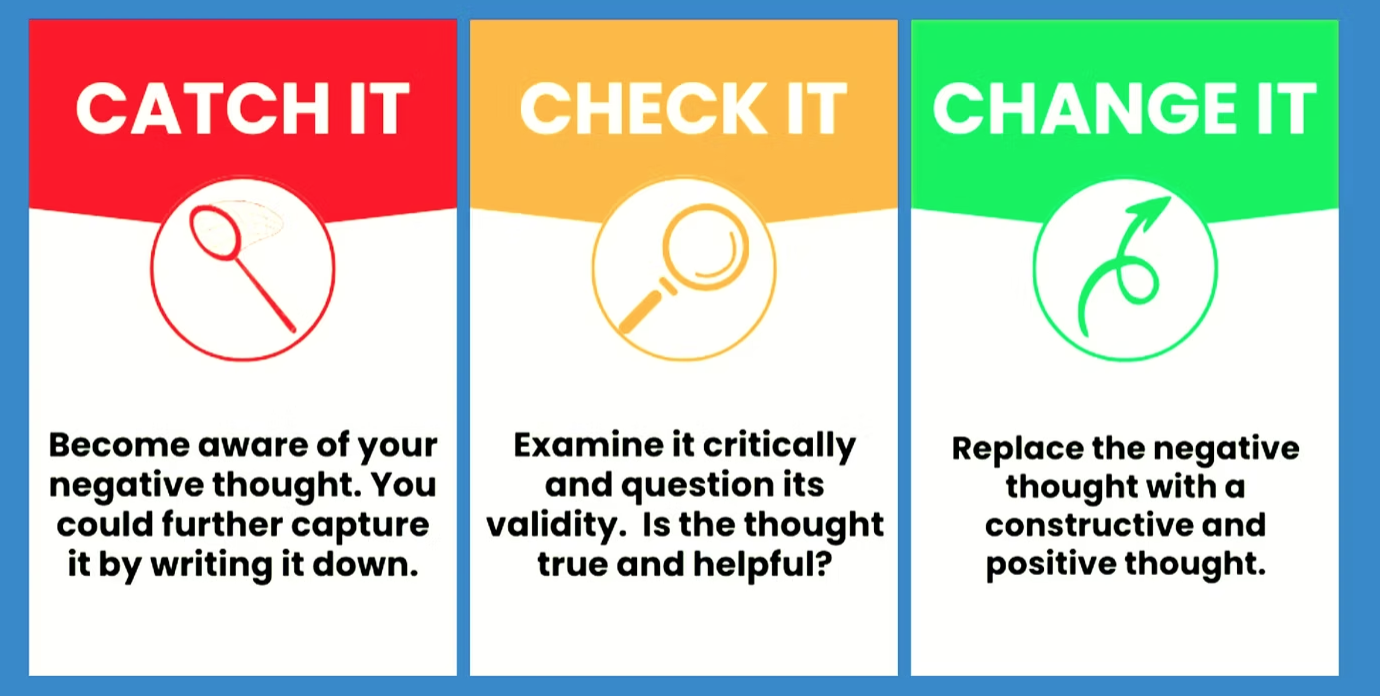
When something unpleasant happens to us, we usually feel angry, disappointed, or anxious. We can use the ‘catch, check and change process’ (a principle of Cognitive Behavioural Therapy or CBT) to determine if we needed to feel this way or are misinterpreting the situation. During the catch and question process:
We slow down and catch and question the first thought
We gain evidence for and against it
We can see if the thought is actually factual or not.
Here’s the good news. If there is one shred of evidence against that first thought, IT’S NOT TRUE. Let me repeat that. If there is one teeny-weeny, itty-bitty whiff of evidence against it, it’s not factual. In which case, we can stop angsting about it (the unhelpful spiral downwards) and do something else. Sound too good to be true? It is pretty simple, and what’s more, IT WORKS. Consider the following example:
The Unhelpful Spiral Downwards
When I went to my business networking group this morning I saw John – we’re best buds in the group – and smiled at him. He looked at me and turned away. My first thought was “Oh no, what have I done to upset him?”. I felt anxious and sick. When someone else came to talk with me later I was preoccupied and couldn’t really talk to them. I was anxious and nervous, and preoccupied about upsetting John. I’ve been stewing about it all day. Going over and over it and wondering what I did wrong. I still feel sick and it’s 7 pm.
The Catch, Check and Change Approach
When I went to my business networking group this morning I saw John – we’re best buds in the group – and smiled at him. He looked at me and turned away. My first thought was “Oh no, what have I done to upset him?”. Then I caught the thought and questioned it: “The evidence for it is that he seemed to look at me and turn away. The evidence against it is that last time we spoke things were OK. I haven’t done anything to upset him. It’s a dim room, it’s possible he didn’t actually see me. He was talking to Steve at the time. He may have been concentrating on what Steve was saying”. So because there is evidence against the thought, it’s not a fact. I went back to my original thought and replaced it with a new factual thought: “I haven’t upset him, he’s busy.” I felt puzzled, and decided to catch up with him later.
In using the catch and question approach, my relationship with John stays intact. My peace of mind stays intact. In fact, no-one was harmed in the making of this scenario. Now it’s your turn.
Use the worksheet in the book over the next few days then come back to learn about dream stories.
Copy as many worksheets as you need and work with them until it becomes second nature. You could also look at the worksheet and use your journal to make notes about what happened. I want you to take notice of an incident or time when you feel uneasy, anxious or upset, and write about it. The incident can be as small or large as you like; remember that nothing is unimportant. Also remember that you are not to judge yourself. These emotional reactions are based in the past and they developed for a good reason. They were part of the trauma effects that we are breaking. But they are now out of date, and we’re going to update them. The scenario below illustrates how to approach the worksheet that follows.
Tears flowed down Dawn’s cheeks. “I think I did the right thing by breaking up with my girlfriend for good this time, but now I’m not sure. I went and saw her yesterday and we hooked up. Now I keep wondering if I have done everything that I can.”
We talked for a while about the relationship and why Dawn ended it. “She wasn’t interested in moving in with me and my kid, she made that pretty clear. In fact, she doesn’t even like my kid. But when I saw her yesterday she said that she could stay one night a week with me and the kid. She wants us to stay together. Now I’m really confused. Is she changing? Should I wait for her to change? It’s already been two years. I want more, I want someone who loves my kid and wants to be with me as a family all the time.”
We decided to use the worksheet to help clarify Dawn’s feelings. She wrote out the event: “Girlfriend said she would come and stay one night a week.” She wrote out her first thought: “Yay she wants to be with me and the kid.” She then wrote out the evidence that this thought was true: “Gf said it, I heard it.” Then she wrote the evidence that it was false: “It’s been two years and no change. She doesn’t even like my kid. I’ve had to separate my mother-self from my girlfriend-self and I’m sick of it. She’s had plenty of time to change. I’ve given her three second chances; she’s not going to change”. The shiny new thought based on fact is: “Gf is not going to change. I need someone who loves the whole of me and who loves my kid.” The new feeling based on that fact is determination. The sparkly new action based on the new feeling is to stay strong and cut all ties after explaining why to the other person.
Dawn gave me a watery smile. “I can do this! It helps to see it in writing, and I can go back to it any time I want”.

Educational Insight - Dream Stories
Dr. Candace says that dreams are direct messages from what she likes to call your ‘bodymind’. Dreams give you valuable information about what’s going on in your mind, as well as with your emotions. It’s like eavesdropping on the conversation that is going on between body and mind. We can access levels of consciousness that are usually beyond our awareness. This is where the magic happens.
Why do we have dreams when we sleep? What is happening when we dream? Different parts of our bodymind are communicating with each other; gossiping like neighbours. We get to hear the gossip in the form of a story, complete with plot and characters using the language of your everyday consciousness. You might dream about someone at work, or your partner, or something that you saw on TV. Dreaming is your psychosomatic network resetting itself each night for the next day. Peptides spill out into your system and bind to receptors. This causes your body to return to normalcy. Information about these readjustments enters your consciousness. This information takes the form of a dream. Since these are the biochemicals of emotion, that dream not only has content, but feeling as well.
As ACoA, we have established that we are good at ignoring or squashing our feelings. Especially the strong ones. But they must go somewhere, so where do they go? Our bodies store them in our cells. At night, some of this stored information bubbles up into consciousness in the form of a dream. Capturing that dream and re-experiencing the emotions can be very healing. What you do with the information is up to you. You can either use it to grow, or you can use it to forgive and let go. Once you make the decision to pay attention to your dreams, they will start to speak to you. You will understand them more over time, with practice. What if you can’t remember your dreams or think you may not even have any? You may find that the act of intending to write them down will help you to become more aware of them. Once you have decided, get ready. Place a pen and notebook by your bedside, or use the next worksheet to help you. Deepak Chopra talks about intention and attention. This is a perfect illustration of what he means. The intention is the decision to capture the dream in writing. The attention is the focus; the readiness to carry out the action created by the intention. In this case, writing down the dream.
Dr. Candace advocates the use of a dream book, and that’s how I jot down my dreams too; thank you, Dr. Candace. I write down the story on the right-hand page and the emotions on the left-hand page. It’s important to get the emotions down, because they are the main point of the dream. We aren’t analysing why you dreamed about the alligator driving Aunt Sally’s new car. We are noticing the feelings you experienced when you were there. Were you jealous? Were you angry? Were you happy? Why was that alligator in the car and why did it drive away? It doesn’t matter, what is important is the feelings you had about the car or the alligator. Or how you felt about the fact that it was driving away.
In the morning when you wake up, stretch, yawn, and reach for your dream book. Write whatever comes to mind, no matter how small of a fragment it is, and try not to filter or edit any of the content. If associations arise—aha! Aunt Sally’s car is the same one my dad had when I was ten!—write them in parentheses. The content is not the main course though. The feelings and emotions you experienced in the dream are.
Always ask yourself what you felt. Always. Include these feelings in the writing. Sometimes the emotions are contrary to the action. You might dream about a tragedy and feel happy. The feeling is the clue. Even if the feelings are disturbing or uncomfortable, it’s vital that you write them down. This is good practice for becoming more aware of your waking emotions and those dream emotions. It’s also good practice to become less judgmental of your own inner processes. Write down any bits of dreams; it doesn’t matter if you don’t remember the whole thing. When I first started my dream book, I would often have a teeny-weeny faint echo of memory to write about. I would end up writing one word, like ‘school’ or ‘forest’ or ‘bullies’. Then on the other side, I would write another couple of words as I remembered the feelings involved. I gradually got better at taking notice. I remembered more, often bringing back whole chunks of the dream. Be sure to write down even the most insignificant-appearing dreams. If you discount a dream that seems boring, you may stop yourself from getting an important message. Often our dreams seem boring because we are protecting ourselves from disturbing content. This is true in real life too. Bored is safer than saying we’re disturbed. Once you write down the boring part, other parts will surface into memory.
Like our emotions and thoughts, our dreams follow the laws of information. They exist on a plane that is beyond time and space.
You now know the secret world of emotions, where emotions live in your body and why they exist. You know how to use them to your advantage, because you can recognise the emotion cycle. You can stop the roundabout and get off any time by using the catch, check and change method. You are able to restore your own peace of mind. You can gaze into the secret world of dreams and listen to yourself at any time.
Next you are going to learn about the second Family Rule - “Don’t Speak”