

Core Values and Expectations
You will get to know yourself even more, discovering what drives you, what your values are and how your expectations are driven by your values.
The World Works Best When…
Perhaps the trauma effects have permeated your being to such an extent that it has made you blind and deaf to yourself and your own values and expectations. As you were growing up, you may have taken on other people’s values and expectations and continued to live by them. You now try to fulfil those values and expectations in ways that frustrate you.
The well-known role you developed while you were growing up influences your core motivation. They are bound together. If you are a Hero, your core values could be that the world works best when you look after everyone. A Mascot could say that the world works best when I make everyone laugh. A Lost Child could say that the world works best when everyone leaves me alone, and an Acting-Out Child could say that the world works best when I’m angry at everyone. It’s hard and takes effort to live by values that aren’t working any more.
We aren’t those children anymore.
When I was a child and forming my map of how the world worked, it didn’t take long for me to realise that if I made people laugh, I would be safe. Petrified of not fitting in, I did whatever I could to belong. I didn’t know what was going on most of the time (still don’t! But now I ask. Sometimes). I felt a strong sense of abandonment, so I tried to fit in wherever and whenever I could. I have a vivid memory of my five-year-old self wandering the playground singing ‘Nobody’s Child’. I also remember very clearly thinking to myself when I was 12 or so, “What do you need? Who do you want me to be? I can be anyone you want.” I’m sure you also have memories of events that formed your map or world view.
How does your world work best? As you work to build up a picture of your world, you can ask yourself these questions (I’m sure you can think of others):
What is important to me?
Is this a value or an expectation?
If it’s an expectation, what is the value driving it?
How do I measure its importance?
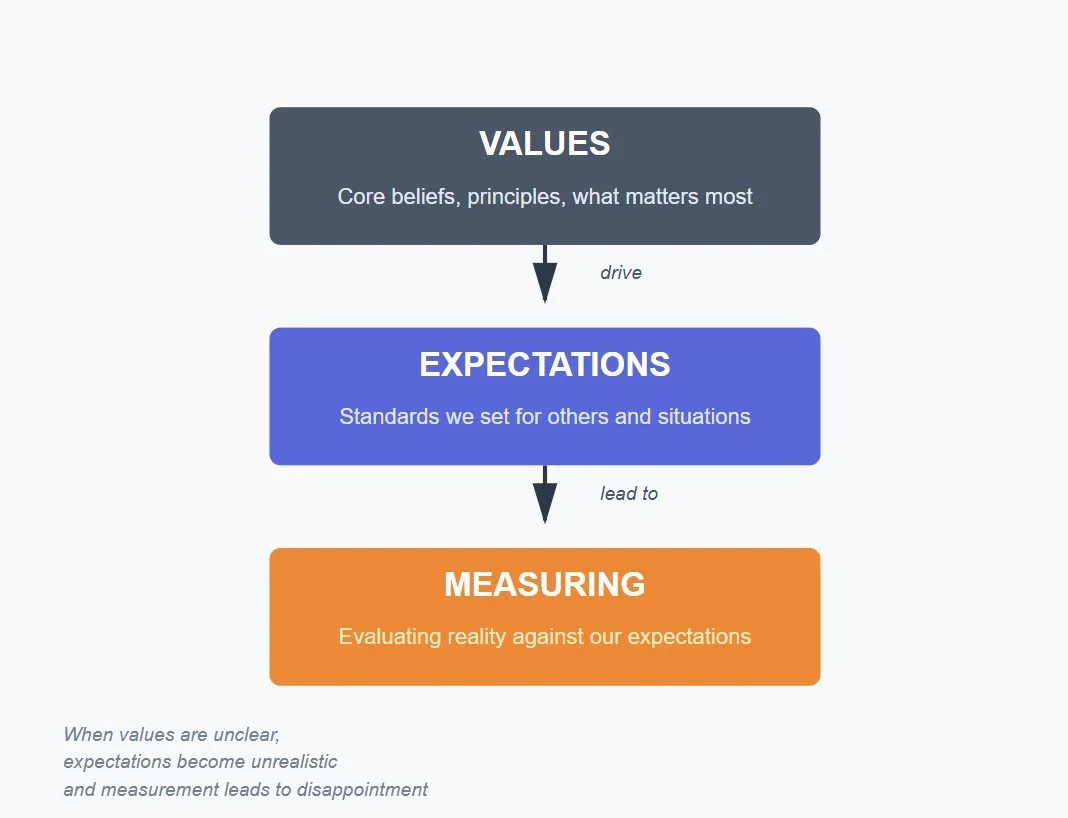
There are so many hidden judgements and expectations driven by our values in everything we do. It’s only when we uncover them that we can understand our own reactions. We were using the only tools we had at our disposal.
Last year I went on a holiday that turned out to be pretty terrible. I did not enjoy it one little bit. I was grouchy and discontented. I made my partner miserable, and I was miserable too. I could not work out what was going on. I told myself I was lucky to be there, that many people don’t get to take holidays. That didn’t work though, and only made me feel ashamed that I couldn’t enjoy it. After the holiday, I decided to work out why I was so miserable on the trip. So I examined my values about holidays, and discovered a lot about myself, my values and my expectations.

Reflective Discovery - Values
Take a look at your own values and expectations. You may not have even had one thought in your life about values.
Discovering your Expectations
What is important to you? How do you want things to work, how do you think people should be? The best way to figure this out is to pick one aspect of your life that you are unhappy with. Write down four or five statements about that one thing that you want to examine. Use the worksheet and write down the first thing that comes to mind. It doesn’t matter if it’s ridiculous and unrealistic. You now have some statements about how you think things should be. Your expectations are driven by your values. But in real life, things are often the opposite of what they ‘should’ be.
Discovering your Values
Now we want to go up the chain and see what is driving those expectations - what are the values. Here is a list of common values that you can choose from:
Core values are deeply personal, and what makes a value "good" often depends on individual circumstances, culture, and personal beliefs. That said, here are some widely recognised values that many find meaningful:
Integrity - Acting in accordance with one's ethical principles
Compassion - Showing concern for the suffering of others
Curiosity - Maintaining a desire to learn and grow
Gratitude - Appreciating what you have
Responsibility - Taking ownership of your actions and their consequences
Perseverance - Continuing despite difficulties
Honesty - Being truthful with yourself and others
Empathy - Understanding others' perspectives and feelings
Courage - Facing fear or uncertainty to do what you believe is right
Fairness - Treating people equitably and without bias
Generosity - Giving freely of your time, resources, or attention
Respect - Honouring the dignity and autonomy of all people
What makes values particularly meaningful is how they align with your authentic self and guide your decisions. A good measure of those values is this test. Do the values:
Resonate personally
Support their well-being
Guide them through difficult decisions
Create positive impact in their relationships and communities
Provide a sense of purpose
Or (and this is what we are examining today), you can have values that apply to specific contexts like holidays. Values don't have to be universal life principles, they can be situation-specific and guide how you approach particular activities or experiences.
For holiday-specific values, the following values might be driving you:
Presence - Valuing being fully engaged with your surroundings and companions rather than distracted
Restoration - Prioritising genuine rest and rejuvenation
Connection - Emphasising meaningful time with loved ones
Discovery - Valuing new experiences and cultural understanding
Simplicity - Appreciating uncluttered time away from usual responsibilities
Spontaneity - Valuing unplanned moments and flexibility
Balance - Ensuring a mix of activity and relaxation
Authenticity - Seeking genuine local experiences rather than tourist traps
Mindfulness - Being present and appreciative of the temporary nature of holiday time
Sustainability - Making choices that respect the places and communities you visit
Freedom and autonomy - Choosing when to relax rules affirms our agency over our own lives
Investment in experience - The notion that significant time investment validates the experience as "worthwhile" or "real"
Using the "the world works best when..." framework around holidays, these might translate to statements like:
"The world works best when people take time to truly disconnect and recharge."
"The world works best when travellers engage respectfully with local cultures."
"The world works best when we create memories through experiences rather than possessions."
These context-specific values can help you make choices that align with what truly matters to you, even in activities that might seem less significant than major life decisions.
Measuring your Values
You now have some values and expectations.
Now you both are going to work out how they measure those values and expectations. When the measures we use to value our experiences and interactions meet our expectations, we are happy and loved. When they don’t, life is crappy and hard. Say for example one of their values is generosity, the expectation is that others should be available to support them no matter what. What does that look like? How do they measure this? Does it mean that others should act as their personal bank? Does it mean that others should babysit their kids whenever they ask them to? Does it mean that generally people should give more than they get?
Remember that there is no right or wrong here. These metrics that determine how we measure values and expectations were established a long time ago. Over the years, they were wound around them tighter and tighter. We are now going to smash the metrics that aren’t working anymore and replace them with ones that work in their current situation. The important thing is to get these metrics or measures out in the open so they can examine them; scrutinise them. It’s in the examination that they will see if they need to adjust, or not. Are the measures they use still valid or relevant? Are they realistic? Are they helpful, especially in the long run?
We are not addressing the value, merely the expectation and the measure of that expectation.
This is my story, my example - please feel free to use it or substitute something that resonates with you.
Going back to my holiday example, I asked myself, what is the essence of a holiday? I decided that for me, the essence was to do something different from my everyday life, rest, prepare for the coming year and have fun (whatever that means). This translates to my core values around this which are ‘discovery, connection and restoration’.
My Values and Expectations about my Holiday
Then I considered my measures for each of the expectations I had identified. I combined some of them if they looked like they could go together:
Value = Connection
Expectation = We must spend every moment together doing the same thing
Measures:
we must eat, drink and sleep together
we must do only the same activities at the same time all the time
we must get up and go to bed at the same time
we must only do things that we both want to do. (In reality this looked like only doing things my partner wanted to do to keep her happy. Or in my head, she would leave.)
Value = Restoration
Expectation = I must not ‘waste time’ doing useful stuff, no exercise allowed. I must do nothing except watch TV/play on the tablet/read fiction/shop/eat out
Measures:
reading fiction/tablet or TV only! Only read easy books, no thinking!
no housework except for dishes
Value = Freedom and autonomy
Expectation = We must eat rubbish food and drink lots of alcohol and come home broke
Measures:
eat whatever you feel like
get drunk a lot
buy stuff you don’t need
let go and do whatever you want as long as it’s not work
As I could see, once I started breaking things down, they became ridiculous. Who the heck is going to have a holiday like this and be happy? Sorry if this sounds like your ideal holiday; it just doesn’t work for me at all. Holidaying in this way made me angsty and downright mean.
Adding measures to expectations, while seeing the values driving this, helps you to break down why you feel dissatisfied sometimes. Now it’s your turn. Go back to your worksheet, and write down the essence of your expectations. Then, for each of the values you wrote down, add some expectations of those, then some measures.
You now have an idea of what is important to you; the values that shape you, and you know how you measure those expectations driven by your values. From now on, you are going to use new and more realistic measures of those expectations. When the measures we use meet our expectations driven by our values, we are happy and loved. When they don’t, life is hard.
You may notice that you make use of these values-driven expectations in more than one aspect of life. If you have a partner at the moment, or have had one in the past, you may have transferred these values and expectations onto them. No judgement; you are using the only tools you have to measure what is important to you. We are now going to update those tools.
Only change your expectations if they need changing. Your values are super important. They make you unique and give you substance.
The same goes for your measures. Only change them if they need changing; if you keep getting disappointed in life, or if you come across a measure that is impossible. If you can’t live up to their measures, how can anyone else?

Value = Connection
Expectation = We must spend every moment together doing the same thing
Measures:
we must eat, drink and sleep together
we must do only the same activities at the same time all the time
we must get up and go to bed at the same time
we must only do things that we both want to do. (In reality this looked like only doing things my darling wanted to do to keep her happy. Or in my head, she would leave).
These measures are not helpful or realistic. Why not? Because I get frustrated when I follow them! Then I get cranky and take it out on my beloved. What are some helpful and more realistic measures?
eat together if we’re both there
we don’t have to go to bed at the same time
only do activities if you want to.
According to the new measures, it’s ok to do some things apart. It’s ok to do some things together. The value stays the same - Connection. The new expectation becomes: It’s ok if we don’t spend every single minute together. Does this fit into my big picture of what a holiday is? Restful, fun, and different? Yes it does.
Value = Restoration
Expectation = I must not ‘waste time’ doing useful stuff, no exercise allowed. I must do nothing except watch TV/play on the tablet/read fiction/shop/eat out
Measures:
reading fiction/tablet or TV only!
only read easy books, no thinking!
no housework except for dishes
no work unless it’s imperative
Some of these measures were kind of helpful, so I decided to keep them. Some of them were unrealistic. Why weren’t the others helpful or realistic? Because by following them I got so bored and restless that I started picking fights just to have something to do. Not fun. The value stays the same - restoration. The new expectation becomes: it’s ok to do some useful thinking or productive stuff sometimes. It’s ok to do nothing sometimes. Does this fit into my big picture of what a holiday is? Restful, fun, and different? Yes it does.
Value = Freedom and autonomy
Expectation = We must eat rubbish food and drink lots of alcohol and come home broke
Measures:
eat whatever you feel like
get drunk a lot
buy stuff you don’t need
let go and do whatever you want as long as it’s not work
indulge yourself
None of these measures were helpful. I ended up feeling unhealthy. I put on weight that became hard to shift. I came home with lots of rubbish souvenirs and no money. Not a great way to start the new year. The value stays the same - Freedom and autonomy. The new measure becomes: it’s ok to let go as long as you don’t hurt yourself in the long run. Does this fit? Is it fun, restful, and different? Yes. Yes, and yes.
I wrote out my brand new sparkly expectations based on my values:
It’s ok to do some things apart. It shows R-E-S-P-E-C-T.
We only have to do the things we want to do; my partner may still choose to do them alone, and that’s ok.
It’s ok to do some useful stuff or productive thinking sometimes. It’s ok to do nothing sometimes.
It’s ok to let go, as long as I’m not hurting myself in the long run.
All the usual mental health whatnot still apply. Be aware of my thinking, eat well, get enough sleep, and don't drink too much.
Read these values every day until they are a part of me.
For the next exercise, use this same method to revisit the measures of your values-driven expectations.
Your Turn
On the previous worksheet, mark whether each measure is helpful, not helpful or kind of helpful. Keep the measures that are helpful, but ditch or change the ones that are unhelpful or kind of unhelpful. Then write out some sparkly new expectations for yourself. Make sure they fit your big picture; the essence of your values.
Now you have an idea of how to examine the values that drive you. You can do this exercise many times to analyse all aspects of your lives: child-rearing, work, relationships, money, where to live, food etc.
With Great Responsibility Comes Great Power
Mark Manson once said “With great responsibility comes great power”. This may be a hard concept for you to get your head around, but it’s liberating to know that you have the great responsibility and power to change your own life. You don’t need to stay captive to outdated expectations and measures any longer. You don’t have to hold on to those old constructs of yourself that don’t quite fit today’s world. You can take the power back and measure your values using the measures that work for them.
This is what I did to address my holiday values: I identified each measure as helpful, not helpful, or kind of helpful, and considered whether they were realistic, not realistic, or kind of realistic. This is what I ended up with:
Healing Intervention
-
This exercise can serve as a gentle yet powerful way to help you transition from the intensity of the session into a state of relaxation and emotional balance. It focuses on connecting with the breath, grounding in the present moment, and fostering a sense of safety and empowerment.
-
Begin by dimming the lights or creating a calm atmosphere with soft music or silence.
Sit comfortably, with your feet firmly planted on the ground or legs crossed.
-
Use this simple breathing technique to ground yourself:
- Inhale deeply through your nose for a count of four.
- Hold your breath for a count of four.
- Exhale slowly through your mouth for a count of four.
- Pause for four counts before repeating.
Repeat this cycle for several minutes, encouraging focusing on the sensation of your breath and letting go of tension.
-
Visualise your values and expectations as seeds planted within you during the session. The seeds are growing stronger with each breath.
Say to yourself the following gentle affirmations if they resonate with you:
- “With each breath, I am reclaiming my strength.”
- “I am safe, grounded, and connected to my values.”
-
After completing several rounds of breathing, allow a few moments of silence to reflect on what you’ve learned or experienced during the session.
-
As we close today’s session, carry this sense of calm and connection with you. Your values are your guiding light - trust yourself as you move forward.